
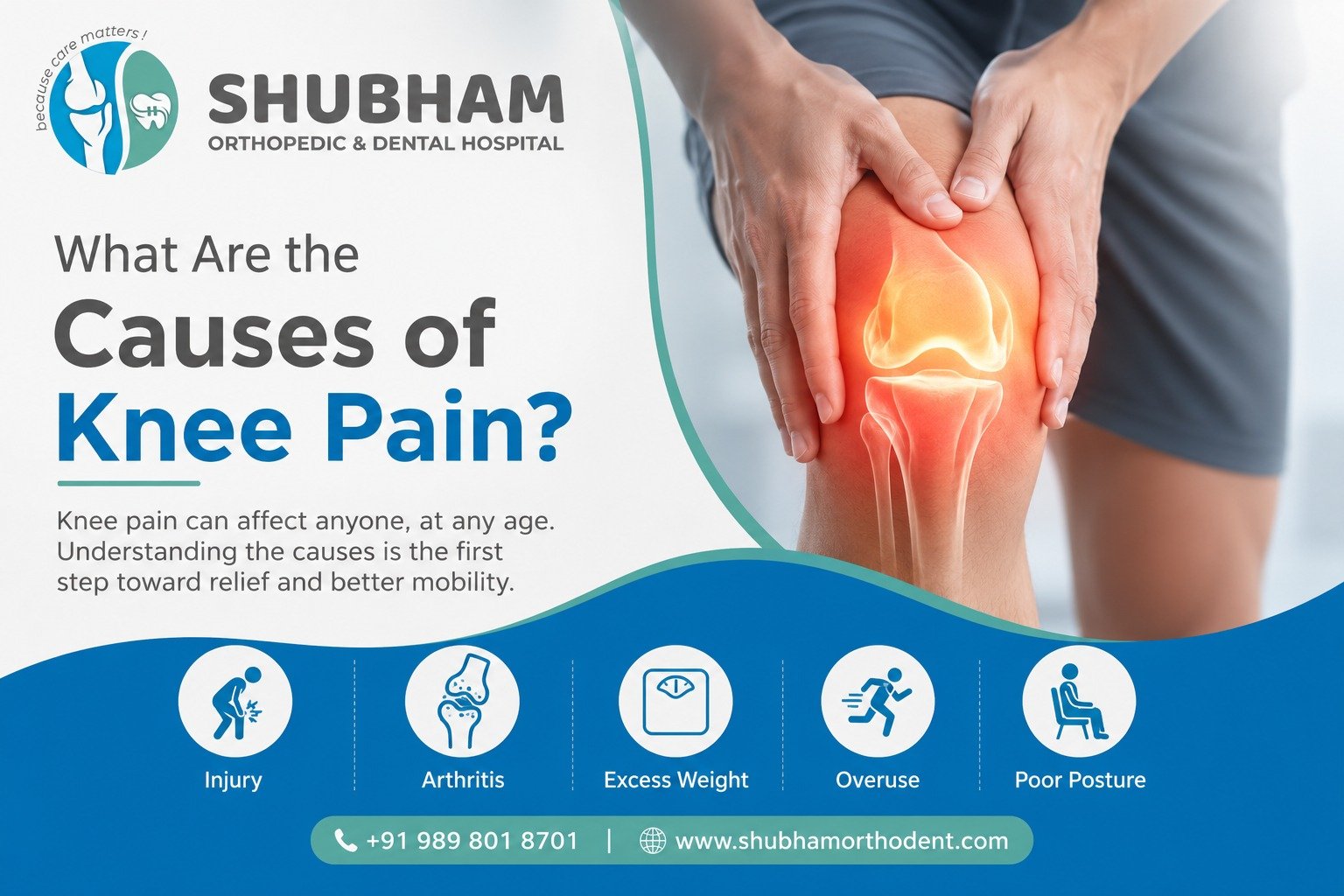
Knee pain is one of the most common reasons people visit an orthopaedic doctor in India. It affects people of all ages, from teenagers with sports injuries to elderly patients with advanced arthritis. Yet most patients wait too long before getting a proper diagnosis.
Understanding the causes of knee pain is the first step toward the right treatment. Some causes are simple and respond to rest and physiotherapy. Others require medical intervention or surgery. Knowing the difference can save years of unnecessary suffering.
In this guide, Dr. Kushal Doshi (MS, DNB Ortho), Orthopaedic Surgeon at Shubham Hospital, Bhavnagar, explains every significant cause of knee pain, how to identify it, and what treatment options are available.
Understanding the causes of knee pain is the first step toward the right treatment. Some causes are simple and respond to rest and physiotherapy. Others require medical intervention or surgery. Knowing the difference can save years of unnecessary suffering.
In this guide, Dr. Kushal Doshi (MS, DNB Ortho), Orthopaedic Surgeon at Shubham Hospital, Bhavnagar, explains every significant cause of knee pain, how to identify it, and what treatment options are available.
| 350M+ People affected by knee pain globally |
40% Adults over 45 report chronic knee pain |
80% Cases treatable without surgery |
6 wks Avg. delay before patients see a doctor |
|---|
Understanding the Causes of Knee Pain
The knee is the largest and most complex joint in the human body. It connects the thigh bone (femur) to the shin bone (tibia), with the kneecap (patella) sitting in front. A network of ligaments, tendons, cartilage, and fluid-filled sacs holds this joint together and allows smooth movement.
When any of these structures is damaged, inflamed, or worn down, pain follows. The causes of knee pain broadly fall into three categories :
- Degenerative : Gradual wear and tear over time, most common in patients above 45.
- Traumatic : Sudden injury from a fall, accident, or sports impact.
- Inflammatory or systemic : Conditions like gout or rheumatoid arthritis that affect the joint through the immune system or metabolic processes.
“Most patients come to me saying their knee pain started suddenly. But when I examine them and review their history, the joint has usually been deteriorating quietly for months or even years. Knee pain rarely appears out of nowhere. It builds. And that is exactly why early evaluation matters so much.”
Dr. Kushal Doshi
MS, DNB Ortho · Orthopaedic Surgeon, Shubham Hospital, Bhavnagar
10 Most Common Causes of Knee Pain
Here is a detailed breakdown of each major cause, what it feels like, who it affects most, and what can be done about it.
Osteoarthritis (OA) of the Knee
Osteoarthritis is the single most common cause of knee pain in adults over 45. It occurs when the protective cartilage that cushions the ends of your knee bones gradually wears down. As cartilage thins, bone rubs against bone, causing pain, stiffness, and swelling. OA worsens over time and is the leading reason for knee replacement surgery in India. Risk factors include age, obesity, prior knee injuries, and a family history of arthritis.
Rheumatoid Arthritis (RA)
Unlike osteoarthritis which is a wear-and-tear condition, rheumatoid arthritis is an autoimmune disease where the body’s immune system mistakenly attacks the joint lining. RA typically affects both knees simultaneously, causes significant morning stiffness lasting more than an hour, and can affect people of any age including younger adults. Proper diagnosis with blood tests and imaging is essential since the treatment approach differs significantly from OA.
ACL and Ligament Injuries
The anterior cruciate ligament (ACL) is one of four major ligaments that stabilise the knee. ACL tears are extremely common in athletes, young adults, and people who play sports involving jumping, sudden direction changes, or pivoting. A classic sign is a loud “pop” at the moment of injury followed by immediate swelling and instability. MCL (medial collateral ligament) injuries are another frequent cause of inner knee pain, typically from direct impact to the outer knee.
Meniscus Tears
The meniscus is a C-shaped piece of cartilage that acts as a shock absorber between the femur and tibia. Each knee has two menisci. Tears occur from sudden twisting movements during sports or from gradual degeneration in older patients. A torn meniscus typically causes pain on the inner or outer side of the knee, locking or catching sensations, and swelling that develops over 24 to 48 hours after injury.
Patellar Tendinitis (Jumper's Knee)
Patellar tendinitis is inflammation of the tendon connecting the kneecap to the shin bone. It is an overuse injury seen most commonly in athletes who jump frequently, particularly basketball, volleyball, and cricket players. The pain is typically felt just below the kneecap and worsens during and after physical activity. Left untreated, it can progress to a tendon tear.
Bursitis of the Knee
Bursae are small fluid-filled sacs that cushion the knee joint. When these sacs become inflamed from repeated pressure, overuse, or a direct blow, the condition is called bursitis. It causes a soft, warm, painful swelling at the front or back of the knee. Prepatellar bursitis, commonly called “housemaid’s knee,” occurs in people who kneel frequently for work. It typically responds well to rest, ice, and anti-inflammatory medications.
Iliotibial Band Syndrome (IT Band)
The iliotibial band is a thick band of tissue running from the hip to the outer knee. In runners, cyclists, and hikers, this band can become tight and inflamed where it crosses the knee, causing a sharp pain on the outer side of the knee that worsens with activity. IT band syndrome is the most common overuse injury in runners and is entirely a soft-tissue problem, meaning it responds well to stretching, physiotherapy, and load management.
Gout and Pseudogout
Gout occurs when uric acid crystals accumulate in the knee joint, triggering sudden, intense attacks of pain, redness, and swelling. While gout more commonly affects the big toe, the knee is the second most frequently affected joint. Pseudogout involves calcium pyrophosphate crystals rather than uric acid but causes similar symptoms. Both conditions are diagnosed by joint fluid analysis and are managed with medications that reduce uric acid levels and control inflammation.
Baker's Cyst (Popliteal Cyst)
A Baker’s cyst is a fluid-filled swelling that forms at the back of the knee. It often develops as a secondary problem caused by another knee condition such as arthritis or a meniscus tear, which causes excess synovial fluid to accumulate. The cyst may be painless but can rupture, causing sudden calf pain and swelling that mimics a deep vein thrombosis. Treating the underlying cause typically resolves the cyst.
Fractures and Bone Injuries
The patella (kneecap) and the ends of the femur and tibia are all vulnerable to fractures from falls, road accidents, and direct trauma. Stress fractures, tiny cracks caused by repetitive force rather than a single impact, are increasingly common in athletes and military personnel. Any fracture involving the knee joint surface requires prompt orthopaedic evaluation since inadequate treatment leads to long-term joint damage and post-traumatic arthritis.
Risk Factors That Increase the Causes of Knee Pain
Certain factors make you more vulnerable to developing knee pain regardless of your age or activity level. Understanding your personal risk factors allows you to take preventive action early.
Common risk factors for knee pain causes
| Excess body weight : Every extra kilogram adds 4 to 6 kg of force on the knee during walking. |
Previous knee injury : A prior ACL tear or fracture significantly increases arthritis risk. |
|---|---|
| Occupation : Jobs requiring prolonged kneeling, squatting, or heavy lifting accelerate joint wear. |
Age : Cartilage thins naturally after 40, increasing vulnerability to all knee conditions. |
| Muscle weakness : Weak quadriceps and hamstrings reduce knee joint stability and increase injury risk. |
Family history : Genetics plays a role in osteoarthritis, rheumatoid arthritis, and gout. |
| Flat feet or high arches : Abnormal foot alignment alters how force travels through the knee. |
Sudden increase in activity : A rapid jump in exercise intensity is a leading cause of overuse injuries. |
How Knee Pain Causes Are Diagnosed
Accurate diagnosis is the foundation of effective knee pain treatment. At Shubham Hospital, Dr. Kushal Doshi uses a combination of clinical examination and imaging to identify the exact cause of your knee pain.
Diagnostic tools used for knee pain
- Clinical examination : Assessment of pain location, range of motion, swelling, tenderness, and joint stability tests for ligaments and meniscus.
- X-ray : Reveals bone changes, joint space narrowing, and fractures. The first imaging test was ordered for most knee pain cases.
- MRI scan : The gold standard for evaluating soft tissue injuries including ligament tears, meniscus damage, and cartilage loss. Provides detailed cross-sectional images without radiation.
- Blood tests: Used when inflammatory or autoimmune conditions like rheumatoid arthritis or gout are suspected. Tests include uric acid, ESR, CRP, and rheumatoid factor.
- Joint aspiration : A small amount of fluid is removed from the knee and analysed for infection, gout crystals, or blood.
Research published by the National Institutes of Health (NIH) confirms that early and accurate diagnosis of the cause of knee pain leads to significantly better treatment outcomes, lower surgery rates, and faster return to function.
When Should You See a Doctor for Knee Pain?
Not every knee ache requires an urgent orthopaedic visit. But certain symptoms are warning signs that should never be ignored. Here is a practical guide to help you decide.
Urgent vs routine: causes of knee pain that need attention
| Symptom | What It May Indicate | Urgency |
|---|---|---|
| Sudden popping sound followed by swelling | ACL tear or meniscus injury | Urgent |
| Knee locked or unable to fully straighten | Loose body or meniscus tear | Urgent |
| Severe swelling after an injury or fall | Fracture or ligament rupture | Urgent |
| Fever with hot, red, swollen knee | Septic arthritis (joint infection) | Emergency |
| Persistent pain for more than 2 weeks | Arthritis, bursitis, or tendinitis | Schedule soon |
| Pain that wakes you at night | Advanced arthritis or tumour | Schedule soon |
| Gradual pain worse in morning or after sitting | Osteoarthritis or RA | Routine consult |
| Pain in athletes after increasing training | IT band or patellar tendinitis | Routine consult |
Treatment Options Based on Knee Pain Causes
Treatment is always guided by the specific cause, severity, and how long the problem has been present. Dr. Kushal Doshi follows a structured approach that always starts with the least invasive option.
Non-surgical treatments
- Physiotherapy and exercise :Strengthening the quadriceps, hamstrings, and hip muscles reduces load on the knee. The most effective long-term treatment for most causes of knee pain.
- Weight management : Reducing body weight directly reduces joint stress and slows disease progression in arthritis.
- Anti-inflammatory medications : NSAIDs reduce pain and swelling in arthritis, bursitis, and tendinitis. Used short-term under medical supervision.
- Corticosteroid injections : Provide targeted relief for inflammatory conditions. Effects last weeks to months.
- Hyaluronic acid injections : Lubricate the knee joint in mild to moderate osteoarthritis.
- Activity modification : Reducing high-impact activities and correcting movement patterns in overuse injuries.
Surgical treatments
- Arthroscopy : Minimally invasive keyhole surgery to repair meniscus tears, remove loose bodies, or reconstruct ligaments including ACL reconstruction.
- Knee replacement surgery : Recommended for advanced osteoarthritis or severe joint damage where conservative treatments have failed. Both partial and total knee replacement options are available at Shubham Hospital, Bhavnagar.
- Fracture fixation: Surgical repair of patella or tibial plateau fractures using plates, screws, or wires.
For a detailed look at recovery after surgical treatment, read our guide on Knee Replacement Recovery Tips: A Week-by-Week Guide.
Preventing the Most Common Causes of Knee Pain
While some causes of knee pain cannot be prevented entirely, the majority of cases can be significantly delayed or reduced in severity through consistent daily habits.
How to reduce your risk of developing knee pain causes
- Maintain a healthy body weight to reduce joint load and slow cartilage wear.
- Exercise regularly with a focus on low-impact activities like walking, swimming, and cycling.
- Strengthen your leg muscles consistently. Strong quadriceps and hamstrings are your knee’s best protection.
- Warm up properly before sports and physical activity to prepare tendons and ligaments.
- Wear proper footwear with good arch support, especially during exercise.
- Avoid prolonged squatting and cross-legged sitting positions that stress the joint surface.
- Do not ignore early knee pain. A small problem addressed early rarely becomes a big one.
- Get regular orthopaedic check-ups after age 40, especially if you have risk factors.
Summary : Key Causes of Knee Pain at a Glance
A quick reference for patients and caregivers.
- Osteoarthritis is the leading cause of knee pain in adults over 45 and the top reason for knee replacement.
- ACL and ligament injuries are the most common traumatic cause, especially in active and younger patients.
- Meniscus tears cause pain, locking, and swelling and can occur in both young athletes and older adults.
- Rheumatoid arthritis is an autoimmune condition that affects both knees and requires different treatment.
- Overuse injuries like patellar tendinitis and IT band syndrome are common in runners and athletes.
- Bursitis and Baker’s cysts are often secondary to other conditions and resolve when the cause is treated.
- Gout and pseudogout cause sudden severe attacks and require blood tests and joint analysis to diagnose.
- Excess body weight is the most modifiable risk factor for knee pain, regardless of the underlying cause.
- Most causes of knee pain respond to non-surgical treatment when diagnosed and treated early.
- Never ignore knee pain lasting more than two weeks, waking you at night, or accompanied by swelling.