
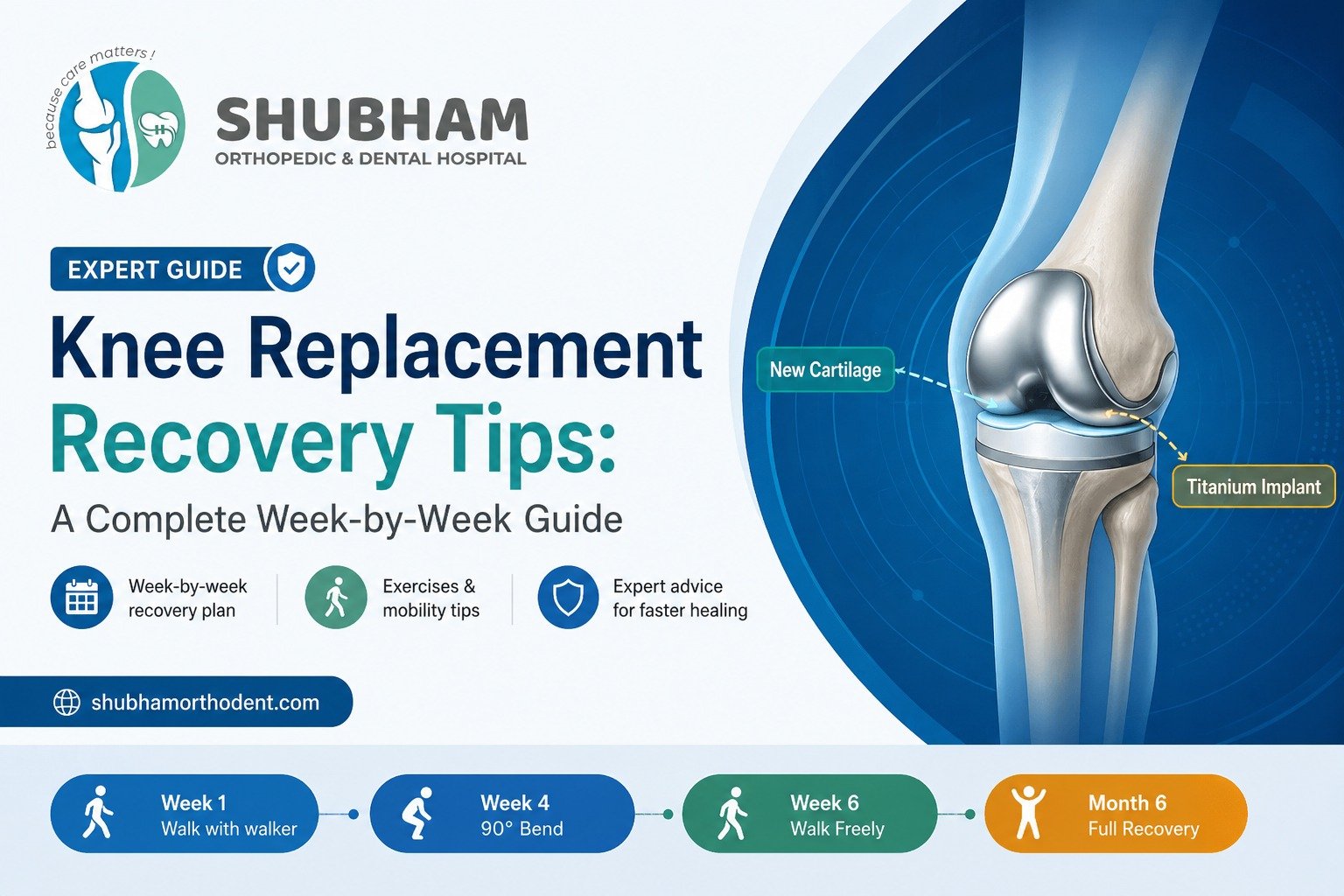
Every year, thousands of patients across Gujarat undergo knee replacement surgery. Many recover well and return to their daily routines within 3–6 months. Others struggle not because their surgery went wrong, but because they didn’t follow a proper recovery plan.
This guide gives you a comprehensive, realistic, week-by-week breakdown of knee replacement recovery written and reviewed by Dr. Kushal Doshi, an orthopaedic surgeon at Shubham Hospital, Bhavnagar.
| 90%+ | 3–6 | 15–20 | Day 1 |
|---|---|---|---|
| Patients report significant pain relief | Months to full functional recovery | Years average implant lifespan | When physiotherapy typically begins |
What to Expect After Knee Replacement Surgery
Understanding the three phases of knee replacement recovery helps you know what’s normal and what requires a call to your surgeon :
- Acute phase (Week 1–2) : Pain, swelling, and limited mobility are normal. Your primary goal is controlling inflammation and preventing blood clots.
- Subacute phase (Week 3–6) : Swelling reduces, range of motion improves. Physiotherapy is intensive during this phase.
- Rehabilitation phase (Week 6–Month 6) : Gradual return to normal activity, strength training, and independence.
“”The patients who recover best from knee replacement are not the youngest or the fittest — they’re the most consistent. Doing your exercises every day, even when you’re tired or in discomfort, is what separates a three-month recovery from a six-month one.”
Dr. Kushal Doshi, MS DNB Ortho, Orthopedic Surgeon, Shubham Hospital, Bhavnagar
Week-by-Week Knee Replacement Recovery Timeline
Hospital Stay & First Steps
- Begin walking with walker on Day 1
- Ankle pump exercises to prevent clots
- Ice packs 20 min every 3–4 hours
- Wound care and dressing changes
- Prescribed pain medication on schedule
Home Recovery & PT Begins
- Progress from walker to crutches
- Physiotherapy 2–3 sessions/week
- Straight leg raises and quad sets
- Aim for 90° knee bend by Week 4
- Short walks inside home
Building Strength & Range
- Walk without assistive device (if cleared)
- Stair climbing practice
- Stationary cycling (low resistance)
- Target 110–120° knee flexion
- Driving may resume (if right knee, check surgeon)
Return to Daily Life
- Resume most daily activities
- Low-impact walking, swimming
- Return to work (desk job: Week 6; physical: Month 3)
- Final implant settling and strengthening
- Follow-up X-ray and evaluation
Knee Replacement Pain Management : What Actually Works
Medication
- Take prescribed pain medication on schedule, not just when pain peaks; it’s harder to catch up to pain than to prevent it.
- NSAIDs (like ibuprofen) help with inflammation, but always follow your surgeon’s guidance on dosage and duration.
- Avoid skipping doses in the first 2 weeks, even if you feel okay.
Ice Therapy
Elevation
💡 Pro tip from our physiotherapy team: The “3 Es” of early knee recovery are Exercise, Elevation, and Ice (Cold). Patients who apply all three consistently in the first 10 days see measurably faster range-of-motion improvements.
Considering Knee Replacement in Bhavnagar?
Physiotherapy Exercises After Knee Replacement
Week 1–2 Exercises (Hospital & Home)
- Ankle pumps : Flex and point your foot 10 times per hour. Prevents DVT (blood clots).
- Quad sets : Tighten your thigh muscle without bending your knee. Hold for 5 seconds, and repeat 10 times.
- Straight leg raises : Lift the operated leg 12 inches off the bed. Builds quad strength safely.
- Heel slides : Slide your heel toward your bottom while lying flat-key for achieving knee bend.
- Short walks : Stand and walk to the bathroom with your walker. Every step counts.
Week 3–6 Exercises (With Physiotherapist)
- Mini squats : Gentle bend to 30–45° against a wall. Builds quadriceps safely.
- Step-ups : Using a low step, gradually increase stair confidence.
- Seated knee flexion : Use gravity to gently increase bend while seated at the edge of a bed.
- Stationary cycling : Begin with a high seat and low resistance once you reach 90° of flexion.
For further reading on evidence-based physiotherapy protocols after total knee arthroplasty, the National Institutes of Health (NIH) has published comprehensive research confirming that early rehabilitation significantly improves long-term outcomes.
Diet and Nutrition During Knee Replacement Recovery
Foods to Eat More Of
- Protein-rich foods : Dal, paneer, eggs, chicken, fish, and soya essential for tissue repair and muscle recovery.
- Vitamin C : Amla, guava, and citrus fruits support collagen formation and wound healing.
- Calcium + Vitamin D : Milk, curd, ragi, leafy greens, and 20 minutes of morning sunlight are critical for bone strength around your new implant.
- Anti-inflammatory foods : Turmeric (haldi), ginger (adrak), omega-3-rich foods like flaxseeds and walnuts reduce postoperative inflammation naturally.
- Hydration : Drink 8–10 glasses of water daily. Dehydration slows healing and increases blood clot risk.
Foods to Avoid
- Processed and fried foods that increase systemic inflammation
- Excessive salt increases water retention and swelling
- Alcohol interferes with medications and impairs healing
- Sugary foods and refined carbohydrates
Knee Replacement Recovery: Do's and Don'ts
Do This
- Do your exercises every single day
- Keep the wound clean and dry
- Sleep on your back with leg elevated
- Use a raised toilet seat (first 6 weeks)
- Wear compression stockings as prescribed
- Report unusual redness, warmth, or fever immediately
- Attend every follow-up appointment
Don't Do This
- Don’t sit cross-legged (jameen par baithna)
- Don’t squat down for 3 months
- Don’t ignore pain that suddenly worsens
- Don’t skip physiotherapy sessions
- Don’t use Indian-style toilets for 6 weeks
- Don’t sleep on your side without pillow support
- Don’t overdo activity on “good days”
Key Recovery Milestones to Track
Day 1–2 : Stand and walk with walker
Week 2 : 90° of knee bend (flexion)
Week 6 : Walk without assistive device
Month 3 : Return to desk work and driving
Month 6 : Full functional recovery
Year 1 : Follow-up imaging and assessment
Common Concerns After Knee Replacement (Answered)
Is it normal to still have pain at 3 months?
How long will I need physiotherapy?
Can I climb stairs after knee replacement?
When can I use an Indian-style toilet again?
Want to understand if you’re a candidate for knee replacement surgery? Read our detailed guide: Total Knee Replacement Surgery at Shubham Hospital, Bhavnagar.
The Mental Side of Knee Replacement Recovery
What helps :
- Having a family member or caregiver present during physiotherapy for support and to learn the exercises too
- Setting small, weekly goals (e.g., “I’ll walk to the gate and back by Friday”)
- Staying socially connected: isolation slows recovery
- Keeping a recovery diary to track your progress and celebrate wins
Quick Summary : 10 Key Knee Replacement Recovery Tips
Start physiotherapy on Day 1 don’t wait until you “feel ready.”
Ice and elevate the leg consistently for the first 2 weeks.
Take pain medication on schedule, not just at peak pain.
Eat high-protein, anti-inflammatory foods throughout recovery.
Target a 90° knee bend by Week 3–4 track it with your physio.
Avoid squatting, cross-legged sitting, and Indian toilets for 6 weeks.
Walk every day, even short distances. Movement is medicine.
Report sudden worsening pain, fever, or swelling immediately.
Keep all follow-up appointments. Complications caught early heal fast.
Be patient; full recovery takes 6 months, not 6 weeks.