A dental implant is the closest thing modern dentistry has to a natural tooth. It looks like a real tooth, functions like a real tooth, and, with proper care, lasts like a real tooth. But for most patients, the dental implant procedure feels like a mystery.
How many appointments does it take? Will it hurt? How long before you have a proper tooth? What exactly does the dentist do during each visit?
In this guide, Dr. Margee Doshi (BDS, MDS Orthodontist) at Shubham Orthopaedic and Dental Hospital, Bhavnagar, explains the complete dental implant procedure step by step in plain language so you walk into your first consultation fully informed.
How many appointments does it take? Will it hurt? How long before you have a proper tooth? What exactly does the dentist do during each visit?
In this guide, Dr. Margee Doshi (BDS, MDS Orthodontist) at Shubham Orthopaedic and Dental Hospital, Bhavnagar, explains the complete dental implant procedure step by step in plain language so you walk into your first consultation fully informed.
| 95%+ Success rate with proper care |
3-6 Months total procedure time |
6 Main steps in the procedure |
15-20 Years average implant life |
|---|
What Is a Dental Implant?
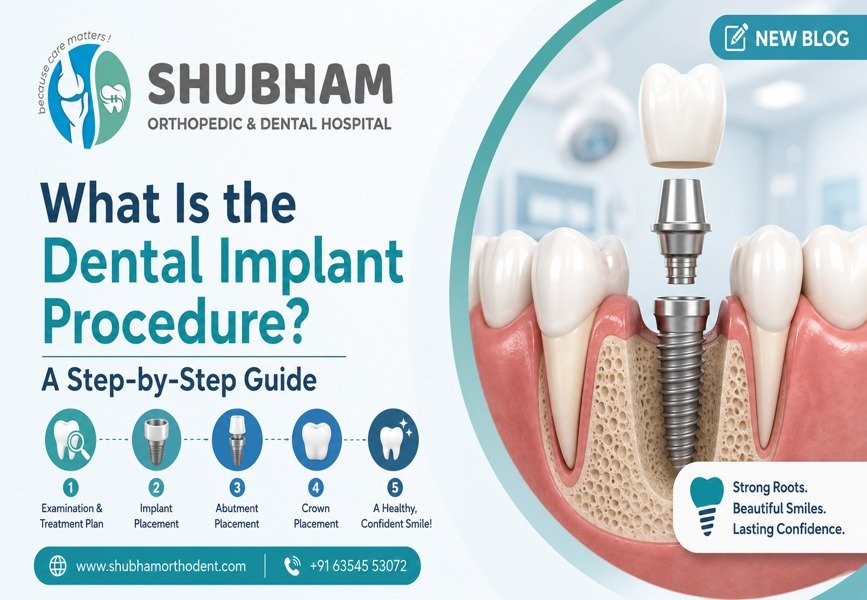
A dental implant is a small titanium screw that is surgically placed into your jawbone to act as the root of a missing tooth. Once the implant fuses with the bone, a biological process called “osseointegration,” a ceramic crown is attached on top, creating an artificial tooth that is virtually indistinguishable from the surrounding natural teeth.
Unlike dentures that sit on the gum surface and can slip, or bridges that require grinding down adjacent healthy teeth, an implant stands alone. It preserves your jawbone, maintains your bite, and does not affect neighboring teeth in any way.
“The most common question patients ask me is whether an implant will feel like their real tooth. The answer, for the vast majority of patients, is yes. Within 3 to 4 months of the final crown placement, most patients forget which tooth was replaced. That is the best outcome in dentistry.”
Dr. Kushal Doshi
MS, DNB Ortho · Orthopaedic Surgeon, Shubham Hospital, Bhavnagar
The Dental Implant Procedure : 6 Steps Explained
The dental implant procedure is not a single appointment. It is a carefully staged process spread over several months to ensure the implant integrates properly with your bone before the permanent crown is placed. Here is exactly what happens at each step.
Step 1 of 6
Initial Consultation and Dental Examination
Your first appointment is a thorough assessment. Dr. Margee Doshi will examine your teeth, gums, and jaw, review your dental and medical history, and take dental X-rays or a 3D cone beam CT scan to assess bone volume, density, and the exact position of nerves and sinuses. This scan is critical; it determines whether you have enough bone for an implant and where exactly the implant should be placed.
If bone loss is detected, a bone graft may be recommended before implant placement. This adds time to the process but is necessary for a stable, lasting result. Most patients are assessed as suitable candidates at this first visit.
Step 2 of 6
Treatment Planning and Implant Selection
Based on the scan results and your specific anatomy, Dr. Margee Doshi creates a customised treatment plan. This includes choosing the correct implant size and brand, designing the final crown digitally, and planning the precise surgical placement angle for maximum bone contact and aesthetic result.
You will also be given a full cost breakdown at this stage, along with a clear timeline. This is the ideal appointment to ask all your questions about the dental implant procedure — there are no wrong questions here.
Step 3 of 6
Implant Placement Surgery
This is the surgical appointment where the titanium implant is placed into your jawbone. The area is numbed thoroughly with local anesthesia before anything begins you will feel pressure and movement but no pain. A small incision is made in the gum, the bone is prepared with a precision drill, and the titanium screw is carefully placed and covered with a healing cap.
The procedure is far less dramatic than most patients expect. The majority describe it as similar in experience to a tooth extraction. Mild swelling, bruising, and discomfort for 3 to 5 days after surgery is normal and well managed with the prescribed medications.
Step 4 of 6
Osseointegration : The Healing Phase
Osseointegration is the biological process where the titanium implant fuses with your jawbone, creating a permanent, stable foundation. This is the most important step in the entire dental implant procedure, and it cannot be rushed. The implant needs to become part of your bone structure before any load is placed on it.
During this period, most patients resume normal eating (avoiding hard foods near the implant site), return to work within a day or two, and experience progressively less swelling. You will have a follow-up appointment in 1 to 2 weeks to check healing, and the next active appointment is typically scheduled at the 8- to 12-week mark.
Step 5 of 6
Abutment Placement
Once osseointegration is confirmed (usually via X-ray), the healing cap is removed and an abutment is attached to the implant. The abutment is a small connector post that protrudes above the gumline and will hold the final crown. In many modern cases this can be placed at the same time as the implant, but in cases with bone grafting or limited bone, a separate appointment is used.
After abutment placement, the gum tissue needs approximately 2 weeks to heal around the connector before impressions for the crown can be taken.
Step 6 of 6
Crown Fitting : Your Final Tooth
The final step of the dental implant procedure is placing the permanent ceramic crown onto the abutment. An impression (digital or conventional) of your teeth is taken and sent to a dental laboratory where a custom crown is fabricated to match the exact shade, shape, and size of your surrounding natural teeth. When the crown is ready, it is permanently cemented or screwed onto the abutment.
At this appointment you will see your complete implant for the first time. Most patients are genuinely surprised by how natural it looks and feels. This marks the end of the active dental implant procedure. You will be given care instructions and advised on routine maintenance to ensure the implant lasts for decades.
Is the Dental Implant Procedure Painful?
This is the question patients ask most often. The honest answer is the procedure itself is not painful at all because it is performed under local anesthesia. The post-surgical recovery involves mild to moderate discomfort for 3 to 5 days comparable to having a tooth extracted.
What to expect during the dental implant procedure surgery
- During surgery : You will feel pressure and movement but no sharp pain. Local anesthesia numbs the entire area completely.
- Day 1 after surgery : As the anesthesia wears off, a dull ache begins. Take your prescribed pain medications before this happens; do not wait for the pain to peak.
- Days 2 to 4 : Swelling peaks on Day 2 and gradually reduces. Discomfort is typically a 3 to 5 out of 10 and is well controlled with over-the-counter medications like ibuprofen.
- Day 5 onwards : Most patients feel close to normal. Eating soft foods for 1 to 2 weeks is recommended near the surgical site.
Dental Implant Procedure Cost in Bhavnagar
Dental implant cost varies depending on several clinical factors. At Shubham Hospital, Bhavnagar, Dr. Margee Doshi provides a detailed cost breakdown at the treatment planning appointment so there are no surprises.
| Single tooth implant (implant + abutment + crown) | Rs. 25,000 to Rs. 60,000 |
|---|---|
| Bone graft (if required due to bone loss) | Rs. 8,000 to Rs. 18,000 |
| Multiple implants (per tooth, discounted for multiple) | Discuss at consultation |
| Full-arch implant-supported denture | Rs. 120,000 to Rs. 220,000 |
The wide cost range exists because implant brand, bone condition, number of teeth, and whether additional procedures are required all affect the final price. The most accurate cost can only be given after examining your specific X-rays and bone scan.
Dental Implant Procedure vs Other Tooth Replacement Options
Understanding how the dental implant procedure compares to dentures and dental bridges helps patients make a fully informed decision.
How the dental implant procedure compares to alternatives
| Factor | Dental Implant | Dental Bridge | Removable Denture |
|---|---|---|---|
| Feels like natural tooth | Yes | Partial | No |
| Preserves jawbone | Yes | No | No |
| Adjacent teeth affected | None | Yes (grinding) | Minimal |
| Lifespan | 15 to 20+ years | 10 to 15 years | 5 to 8 years |
| Eating ability | Full function | Good | Restricted |
| Daily removal required | No | No | Yes |
| Initial cost | Highest | Medium | Lowest |
| Long-term value | Best | Good | Lowest |
Research published by the National Institutes of Health (NIH) confirms that dental implants demonstrate significantly superior long-term outcomes in patient satisfaction, bone preservation, and function compared to conventional tooth replacement options, with 10-year survival rates consistently above 95%.
How to Care for Your Implant After the Dental Implant Procedure
A dental implant is low maintenance but not zero maintenance. The crown itself cannot decay, but the gum tissue around the implant can develop peri-implantitis (implant gum disease) if not cleaned properly.
Daily care routine after the dental implant procedure
- Brush twice daily, including around the implant crown, with a soft-bristle toothbrush.
- Floss daily using implant-specific floss or an interdental brush to clean beneath the crown margin.
- Use an antiseptic mouthwash once a day, especially for the first 6 months.
- Avoid biting hard objects like ice, pens, and fingernails that can damage the ceramic crown.
- Attend 6-monthly check-ups at Shubham Hospital so Dr. Margee Doshi can monitor the implant, gum tissue, and surrounding teeth.
- Quit smoking if applicable. Smoking is the single biggest risk factor for implant failure, doubling or tripling the complication rate.
For more information about our complete range of dental services at Shubham Hospital, visit our Dental Implants Treatment, where you can also find before and after cases from our patients in Bhavnagar.
Summary
- The dental implant procedure has 6 stages: consultation, planning, surgery, healing, abutment, and crown.
- The total process takes 3 to 6 months; most of this is the biological healing phase, not active treatment.
- The surgery itself is painless under local anesthesia. Post-op discomfort lasts 3 to 5 days.
- Osseointegration, titanium fusing with bone, is the most critical and time-sensitive step.
- Implants last 15 to 20 years with a 95%+ success rate better than any other tooth replacement.
- Single tooth implant cost in Bhavnagar: Rs. 25,000 to Rs. 60,000, depending on your specific case.
- Daily brushing, flossing, and 6-monthly check-ups are essential for long-term implant success.
- A cone beam CT scan at the first consultation determines whether you are an implant candidate.