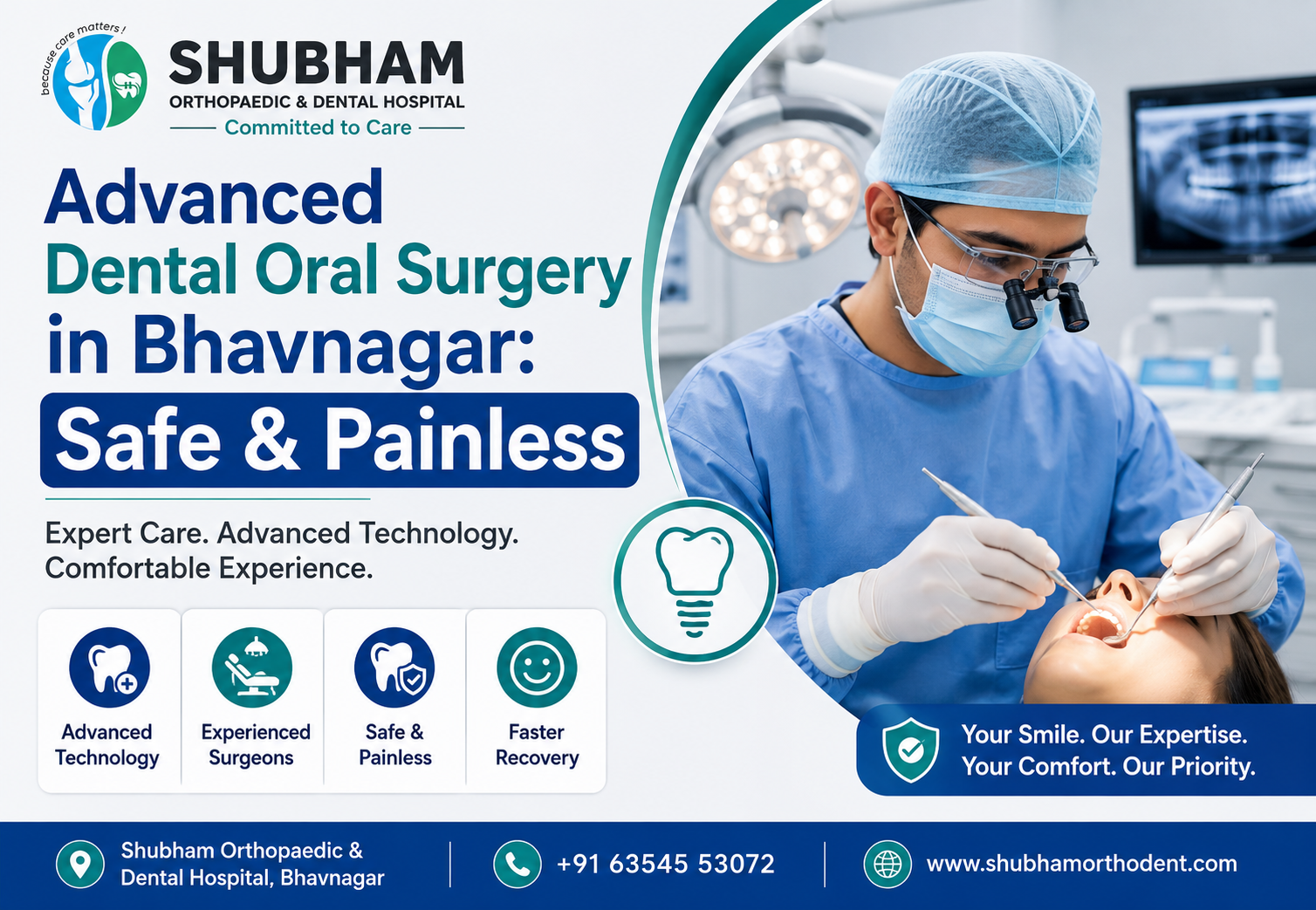
The phrase “dental surgery” makes many patients immediately nervous. The reality in 2026 is very different from what the words suggest. Modern dental oral surgery is precise, comfortable, and in most cases completely painless during the procedure itself.
Whether you need a wisdom tooth removed, a damaged tooth extracted, jaw surgery, or dental implant-related bone grafting, dental oral surgery in Bhavnagar at Shubham Hospital is performed by Dr. Margee Doshi (BDS, MDS) using advanced instruments, digital imaging, and local anaesthesia techniques that make each procedure far more comfortable than patients expect.
This complete guide covers everything you need to know: what dental oral surgery is, the types available in Bhavnagar, what each procedure involves, how to recover safely, costs, and how to know when surgery is actually necessary.
What Is Dental Oral Surgery?
Dental oral surgery is the branch of dentistry that addresses conditions requiring surgical intervention inside the mouth, including tooth removal, jaw correction, soft tissue procedures, and surgical preparation for dental implants. It goes beyond what a routine filling, cleaning, or crown can treat.
Dental oral surgery in Bhavnagar at Shubham Hospital covers conditions ranging from simple tooth extractions performed in minutes to complex surgical procedures requiring careful pre-operative planning and multi-stage execution.
All oral surgery at Shubham Hospital is performed under local anaesthesia as a day procedure. Patients are awake, comfortable, and go home the same day in the vast majority of cases.
Types of Dental Oral Surgery Available in Bhavnagar
Shubham Hospital offers a comprehensive range of dental oral surgery procedures in Bhavnagar under one roof. Here is a clear overview of each type, what it treats, and what the cost range is.
Simple Tooth ExtractionRoutine oral surgery
Removal of a tooth that has erupted fully and can be accessed with standard extraction forceps under local anaesthesia. Used for severely decayed teeth, loose teeth due to advanced gum disease, or teeth that cannot be restored. Most simple extractions take 5 to 15 minutes. |
Wisdom Tooth RemovalSurgical or simple extraction
Third molars (wisdom teeth) frequently erupt partially, at an angle, or not at all. Impacted wisdom teeth cause pain, swelling, infection, and damage to adjacent teeth. Surgical removal involves a small incision in the gum, bone removal if needed, and division of the tooth before extraction. Recovery is 5 to 10 days. |
Surgical Tooth ExtractionFor broken or retained roots
When a tooth is broken below the gumline, has curved roots, or has retained roots after a previous extraction, a surgical approach is needed. A small incision is made to access and remove the root fragment safely without damaging surrounding structures. |
Bone GraftingPre-implant preparation
When the jawbone has resorbed due to tooth loss or infection and is insufficient for an implant, bone grafting adds bone material to the deficient area. This allows the site to accept a dental implant 3 to 6 months later. Both socket preservation grafts and larger ridge augmentation grafts are performed at Shubham Hospital. |
FrenectomyFrenum removal
A frenectomy removes or repositions the frenum, the small fold of tissue connecting the lip or tongue to the gum or floor of the mouth. Indicated for lip-tie or tongue-tie in infants and children, or for frenum attachments that cause a gap between front teeth or restrict denture movement in adults. |
Dental Cyst and Abscess TreatmentIncision, drainage, cystectomy
Dental cysts and abscesses require surgical drainage or complete removal. Periapical cysts, dentigerous cysts, and gum abscesses that do not resolve with antibiotics or root canal treatment require surgical intervention. Cystectomy removes the cyst lining completely to prevent recurrence. |
When Is Dental Oral Surgery in Bhavnagar the Right Choice?
Dental oral surgery is recommended when a dental condition cannot be resolved by non-surgical treatment alone. Here are the most common clinical indications:
- A tooth is too damaged, decayed, or fractured to be restored with a filling, crown, or root canal
- A wisdom tooth is impacted or causing recurring pain, infection, or damage to adjacent teeth
- Gum disease has progressed to a point where surgical debridement is required
- A dental cyst, benign tumour, or unexplained swelling in the jaw requires biopsy or removal
- Jawbone volume is insufficient for a dental implant and bone grafting is needed
- A frenum attachment is causing speech difficulty, a gap between front teeth, or denture instability
- An abscess has not responded to antibiotics and requires surgical drainage
Research published by the National Institutes of Health (NIH) confirms that modern local anaesthesia techniques achieve complete pain elimination during routine dental oral surgery in over 97% of patients, with post-operative pain being mild to moderate and resolving within 3 to 5 days in the vast majority of cases.
Why Dental Oral Surgery in Bhavnagar Is Painless
Effective Local AnaesthesiaAdministered precisely at the surgical site before any instrument touches the tissue. You feel pressure and movement but zero pain. Modern agents work within 3 to 5 minutes and last well beyond the procedure duration. |
Advanced Surgical InstrumentsPiezoelectric bone surgery units, micro-surgical instruments, and high-speed surgical handpieces reduce procedure time, tissue trauma, and post-operative swelling compared to older surgical methods. |
Digital Pre-Surgical PlanningDigital X-rays and CBCT imaging allow Dr. Margee Doshi to plan every surgical step precisely before entering the operating field. Precise planning means shorter, cleaner procedures with less tissue disruption. |
Post-Operative Pain ProtocolPrescribed anti-inflammatory medication is provided before the anaesthesia wears off, preventing the post-surgical pain peak before it occurs. Most patients need only mild over-the-counter analgesics after 48 hours. |
Recovery After Dental Oral Surgery
A smooth recovery from dental oral surgery depends entirely on following the post-operative instructions carefully for the first 48 to 72 hours.
After Oral Surgery: Do This
- Bite on the provided gauze for 30 to 45 minutes after extraction to control bleeding
- Apply ice pack to the cheek for 20 minutes on and 20 minutes off for the first 24 hours
- Eat soft foods for 3 to 5 days: dal, khichdi, curd, soup, banana
- Take prescribed antibiotics and anti-inflammatory medication on schedule
- Rinse gently with warm salt water from Day 2 onwards
- Sleep with your head slightly elevated for the first 48 hours
- Attend your follow-up appointment as scheduled
After Oral Surgery: Avoid This
- Do not spit, rinse hard, or use a straw for 24 hours — this dislodges the blood clot
- Do not smoke for at least 72 hours — smoking causes dry socket
- Do not eat hard, crunchy, or spicy food near the surgical site
- Do not touch or probe the surgical site with your tongue or finger
- Do not take aspirin as it increases bleeding
- Do not drink alcohol for 48 hours after surgery
- Do not skip prescribed antibiotics even if you feel better
Summary
Dental oral surgery in Bhavnagar at Shubham Hospital covers tooth extraction, wisdom tooth removal, bone grafting, frenectomy, cyst treatment, and more.
All procedures are performed under local anaesthesia. The procedure itself is completely painless for the patient.
Dr. Margee Doshi (BDS, MDS) is the specialist performing all dental oral surgery at Shubham Hospital.
Wisdom tooth removal costs Rs. 1,500 to Rs. 6,000 depending on whether it is a simple or surgical extraction.
Recovery from routine oral surgery takes 3 to 7 days. Wisdom tooth surgery may require 5 to 10 days.
Avoid spitting, using a straw, smoking, or eating hard food for the first 24 to 72 hours after oral surgery.
Delaying dental oral surgery almost always results in a larger, more expensive, and more complex procedure later.
Call Shubham Hospital immediately for post-operative complications including increasing pain after Day 3, fever, or swelling that is growing rather than reducing.