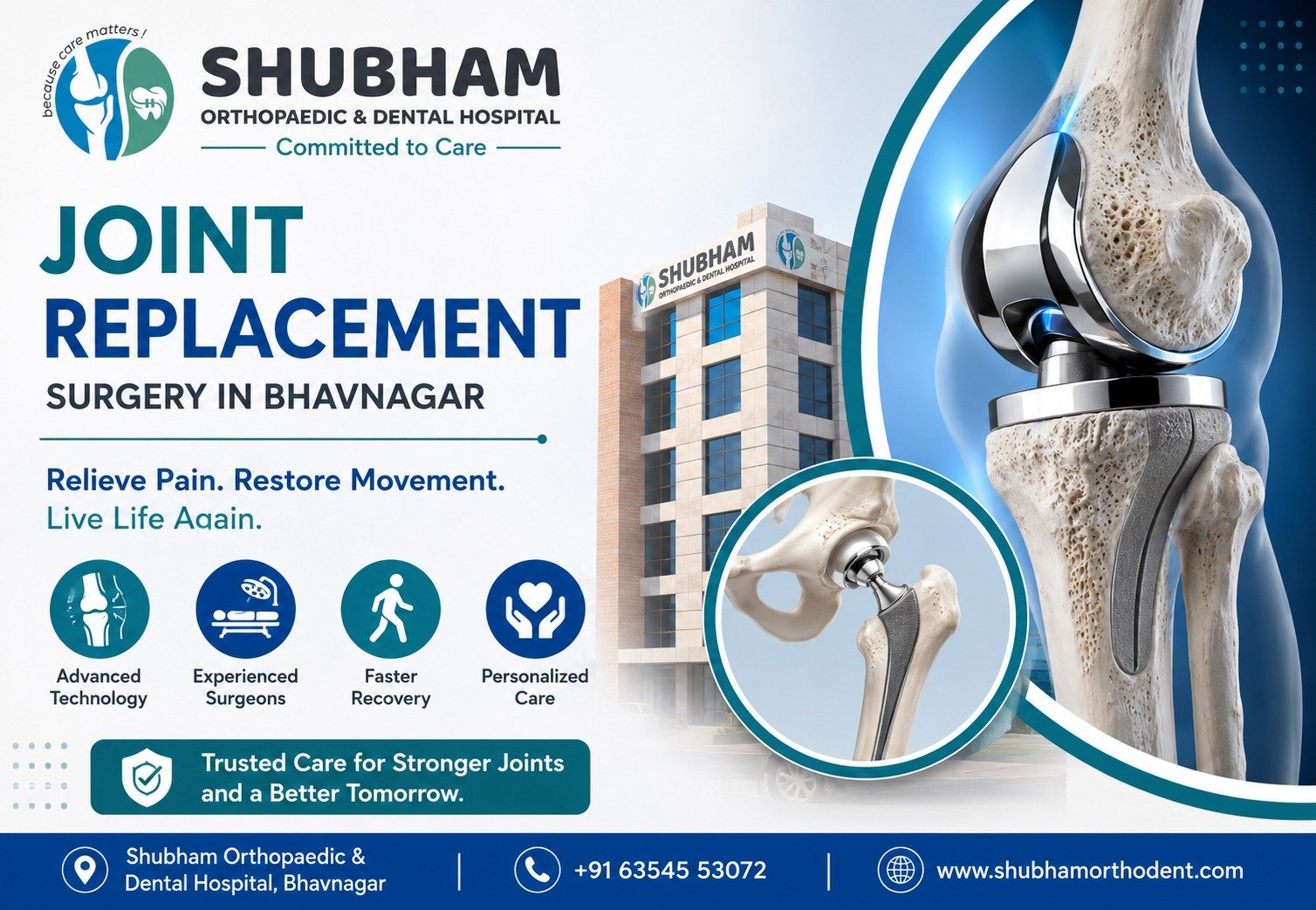
Joint pain that stops you from walking, climbing stairs, or sleeping through the night is not something you have to accept as part of ageing. For thousands of patients across Bhavnagar and Gujarat, joint replacement surgery has restored the ability to move, live independently, and return to the activities they gave up years ago
This guide covers everything you need to know about joint replacement surgery in Bhavnagar which conditions it treats, what the procedure involves, who qualifies, what it costs, and what recovery looks like, all explained by Dr. Kushal Doshi (MS, DNB Ortho) at Shubham Orthopaedic and Dental Hospital, Bhavnagar.
What Is Joint Replacement Surgery?
Joint replacement surgery, also called arthroplasty, involves removing a damaged or worn joint and replacing it with an artificial implant made of medical-grade metal, ceramic, and high-performance polymer. The implant recreates the smooth, pain-free movement of a healthy joint and is designed to last 15 to 20 years under normal use.
India performs over 3 lakh joint replacement surgeries every year with success rates consistently above 95 percent. Joint replacement surgery in Bhavnagar at Shubham Hospital gives patients in Gujarat access to specialist-level care without the burden of traveling to distant metropolitan cities.
Types of Joint Replacement Surgery Available in Bhavnagar
Shubham Hospital offers all major types of joint replacement surgery in Bhavnagar under one roof with Dr. Kushal Doshi as the lead operating surgeon.
Knee Replacement
Total or Partial
The most commonly performed joint replacement surgery in Bhavnagar. The damaged femoral and tibial joint surfaces are replaced with metal and polyethylene components. Total knee replacement is used when the entire joint is affected. Partial replacement preserves healthy bone when only one compartment is damaged.
Hip Replacement
Total or Hemiarthroplasty
Total hip replacement removes the damaged femoral head and acetabulum and replaces them with a metal cup and ceramic or metal ball on a titanium stem. Hemiarthroplasty replaces only the femoral head and is used primarily for femoral neck fractures in older patients.
Shoulder Replacement
Total or Reverse
Total shoulder replacement recreates the ball-and-socket structure of the shoulder. Reverse shoulder replacement switches the positions of the ball and socket and is specifically designed for patients with severe rotator cuff damage alongside arthritis.
Other Joint Surgeries
Ankle, Elbow, Wrist
Dr. Kushal Doshi also manages complex joint injuries of the ankle, elbow, and other joints including arthroscopic procedures, ligament reconstruction, and fracture fixation at Shubham Hospital, Bhavnagar.
Who Needs Joint Replacement Surgery in Bhavnagar?
Joint replacement surgery is recommended when joint damage is advanced enough that conservative treatments including physiotherapy, medications, and injections are no longer providing adequate relief.
Common conditions treated by joint replacement surgery in Bhavnagar
Severe osteoarthritis: The leading indication for knee and hip replacement. Cartilage has worn away, causing bone-on-bone contact, persistent pain, and significant functional limitation.
Rheumatoid arthritis: Autoimmune joint destruction that has caused irreversible damage despite medical management.
Avascular necrosis (AVN): Loss of blood supply to the femoral head causing progressive bone collapse. Common in younger patients on long-term steroids.
Post-traumatic arthritis: Arthritis developing after a joint fracture or injury, where irregular joint surfaces cause accelerated cartilage wear.
Femoral neck fractures: Complex hip fractures in older patients where replacement provides more reliable recovery than fixation.
Rotator cuff arthropathy: Combined massive rotator cuff tear and secondary shoulder arthritis, best treated with reverse shoulder replacement.
The Joint Replacement Surgery Procedure
Understanding what happens during joint replacement surgery in Bhavnagar removes anxiety and helps patients prepare properly for each stage of the process.
1. Pre-Surgery
Consultation, Imaging, and Pre-Operative Assessment
X-rays and sometimes MRI are used to assess joint damage extent. Blood tests, ECG, and anaesthesia evaluation confirm surgical readiness. Implant size and type are planned digitally. Patients are counselled about what to expect at every stage.
Duration: 1 to 2 weeks of preparation
2. Surgery Day
Joint Replacement Operation
Performed under spinal or general anaesthesia. The damaged joint surfaces are precisely removed and the implant components are fixed into place with bone cement or a cementless press-fit technique depending on bone quality. The incision is closed in layers with absorbable sutures.
Duration: 60 to 120 minutes per joint
3. Day 1 Post-Surgery
First Steps with Physiotherapist
Most patients stand and take their first steps on the day after surgery with physiotherapist support. This early mobilisation is intentional and clinically essential for preventing blood clots, reducing swelling, and initiating the healing process.
Hospital stay: 3 to 5 days typically
4. Week 2 to 6
Home Recovery and Physiotherapy
Progressive physiotherapy exercises build strength, range of motion, and balance. Most patients transition from walker to cane to independent walking during this phase. Pain reduces steadily week by week.
Duration: 4 to 6 weeks
5. Month 3 to 6
Full Functional Recovery
Return to work, driving, and most daily activities. Low-impact exercise including swimming and cycling is encouraged. Follow-up imaging confirms implant positioning and bone integration.
Full recovery: 3 to 6 months
Joint Replacement Surgery Recovery
Patients who understand each recovery milestone engage more actively with physiotherapy and experience better long-term outcomes from their joint replacement surgery in Bhavnagar.
Day 1 to 2
Stand and Walk with Physiotherapist Support
Most patients take their first steps the day after surgery. This is intentional and essential for blood clot prevention and early healing stimulation.
Week 2 to 3
Discharge Home with Walker
Sutures or staples are removed. Pain is well controlled with oral medication. Wound healing is monitored at follow-up. Home exercises and physiotherapy begin.
Week 6
Walk Without Assistive Device
Most patients progress from walker to independent walking. Stair climbing is practiced with confidence. Return to driving is discussed with the surgeon.
Month 3
Return to Daily Activities and Desk Work
Most daily activities are fully manageable. Return to desk work, light shopping, and household tasks. Low-impact exercise cleared.
Month 6
Strength and range of motion are close to normal. Annual follow-up X-ray confirms implant integration. Most patients are living fully active lives.
Summary
Joint replacement surgery in Bhavnagar at Shubham Hospital covers knee, hip, shoulder, and complex joint procedures.
Dr. Kushal Doshi (MS, DNB Ortho) is the lead surgeon with specialist qualifications in joint replacement and trauma surgery.
International implant brands including Zimmer Biomet, Stryker, and DePuy are used for all joint replacements.
Cost of knee replacement in Bhavnagar starts from Rs. 1.75 lakh. Mediclaim and cashless facility accepted.
Most patients walk on Day 1 after surgery. Full functional recovery takes 3 to 6 months.
24/7 emergency orthopaedic availability means complications can be addressed immediately without traveling.
In-hospital physiotherapy beginning within 24 hours of surgery is a key feature of Shubham Hospital’s care protocol.
Patients from Palitana, Sihor, Vallabhipur, Mahuva, and Botad are all served without long-distance travel.