
Hip pain does not just hurt. It takes things away from you. It takes away your morning walk. It takes away your ability to climb stairs without holding the wall. It takes away your independence, your sleep, and slowly, your confidence.
For patients who have lived with severe hip arthritis, avascular necrosis, or hip fracture complications for months or years, hip replacement surgery is not just a medical procedure. It is a restoration of life.
In this guide, Dr. Kushal Doshi (MS, DNB Ortho), Trauma and Joint Replacement Surgeon at Shubham Orthopaedic and Dental Hospital, Bhavnagar, walks you through every significant benefit of hip replacement surgery backed by clinical outcomes and real patient experience.
For patients who have lived with severe hip arthritis, avascular necrosis, or hip fracture complications for months or years, hip replacement surgery is not just a medical procedure. It is a restoration of life.
In this guide, Dr. Kushal Doshi (MS, DNB Ortho), Trauma and Joint Replacement Surgeon at Shubham Orthopaedic and Dental Hospital, Bhavnagar, walks you through every significant benefit of hip replacement surgery backed by clinical outcomes and real patient experience.
What Is Hip Replacement Surgery?
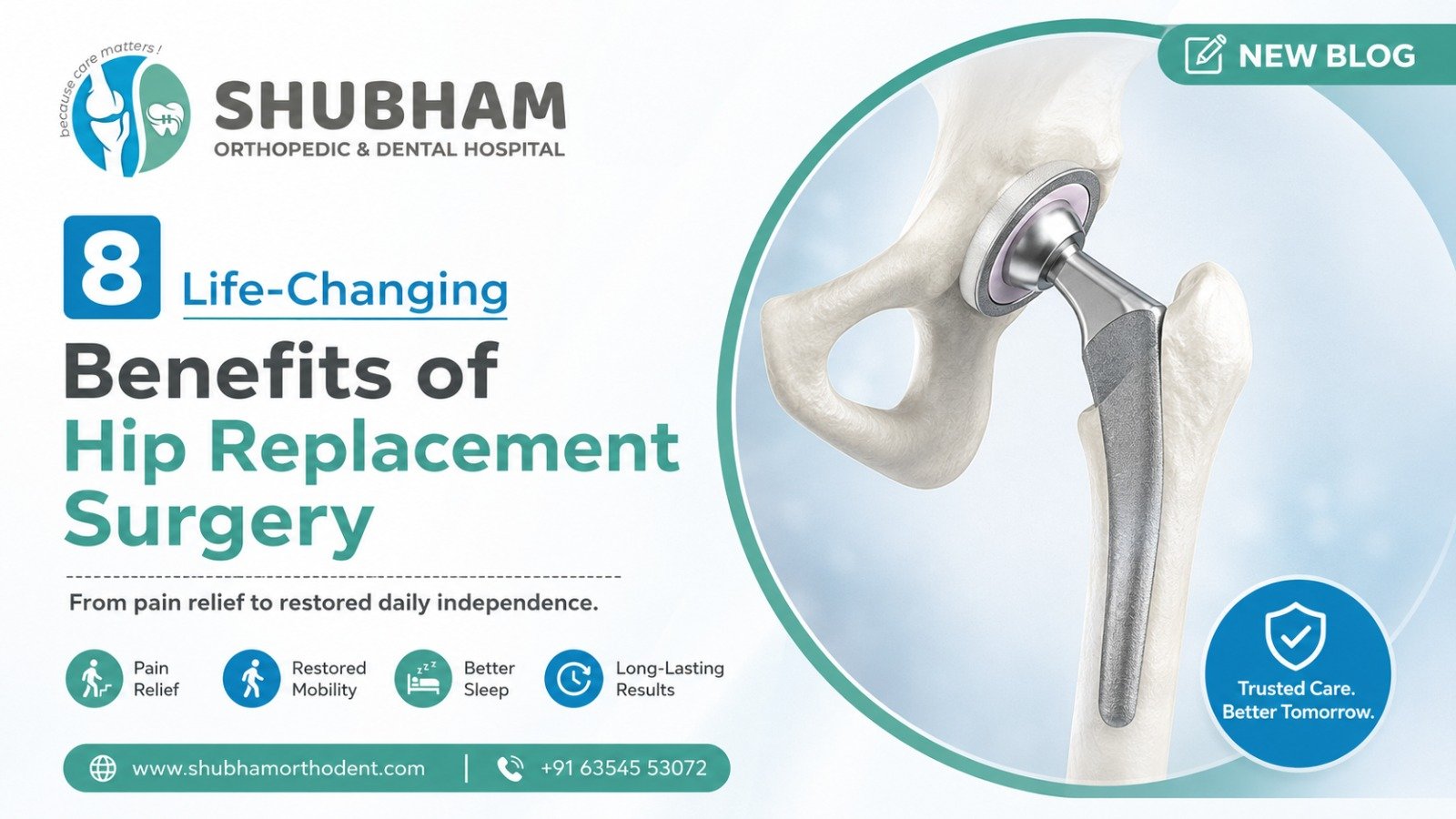
Hip replacement surgery, also called hip arthroplasty, involves removing the damaged parts of the hip joint and replacing them with an artificial implant made of metal, ceramic, and high-grade polyethylene. The implant recreates the ball-and-socket structure of your natural hip, allowing smooth, pain-free movement.
There are two main types performed at Shubham Hospital, Bhavnagar :
- Total hip replacement : Both the femoral head (ball) and acetabulum (socket) are replaced. The most common type, recommended for severe arthritis and advanced joint damage.
- Partial hip replacement (hemiarthroplasty) : Only the ball portion is replaced. Used primarily for femoral neck fractures in older patients.
8 Life-Changing Benefits of Hip Replacement Surgery
Here is a detailed look at each benefit, what patients actually experience, and why hip replacement surgery consistently ranks among the most impactful surgical procedures available.
Dramatic and Long-Lasting Pain Relief
This is what brings most patients to the consultation room. The deep, aching, bone-on-bone pain of hip arthritis or avascular necrosis disappears after surgery because the source of the pain in the damaged joint surfaces has been removed and replaced. Over 90% of patients report significant or complete pain relief. Many describe the first pain-free morning after decades of discomfort as one of the most emotional experiences of their recovery.
Restored Walking Ability and Daily Mobility
Most patients with severe hip arthritis walk with a limp, cannot walk more than a few minutes without stopping, and avoid stairs entirely. After hip replacement surgery, walking ability returns progressively over 3 to 6 months of physiotherapy. Most patients can walk without a limp, climb stairs, get in and out of a car, and move freely through their home. Activities that were abandoned years earlier become possible again.
Elimination of Night Pain and Improved Sleep
Hip arthritis pain is notorious for being worse at night. The constant ache prevents deep sleep, leads to fatigue, irritability, and reduced immunity. After hip replacement surgery, night pain is typically among the first things to improve, often dramatically better within the first 2 to 3 weeks. Patients who have not slept properly in years report sleeping through the night as one of the most immediate and meaningful changes in their life after surgery.
Return to Full Daily Independence
Severe hip disease erodes independence gradually and often invisibly. Patients stop cooking because standing at the stove is too painful. They stop bathing independently. They stop visiting family. After hip replacement surgery, the ability to dress, bathe, cook, and move through the home without help from a family member is restored. This restoration of independence has a profound effect on a patient’s dignity and self-confidence.
Implant Durability of 15 to 20 Years
Modern hip implants using ceramic-on-ceramic or ceramic-on-polyethylene articulation surfaces are designed to last 15 to 20 years with normal use. For patients in their 60s and 70s, this often means a single surgery for the rest of their life. Younger patients in their 50s may eventually need a revision, but advances in implant technology are extending durability significantly. The one-time nature of the procedure combined with life-changing outcomes makes the benefit to cost ratio of hip replacement surgery exceptionally high.
Significant Improvement in Mental Health and Mood
Chronic pain is one of the leading causes of depression and anxiety. Years of unmanaged hip pain isolate patients socially, limit their ability to work, and fundamentally alter their personality and outlook. Research consistently shows that successful hip replacement surgery produces measurable improvements in depression scores, anxiety levels, and overall psychological wellbeing independent of physical recovery. Patients often describe feeling “like myself again” within 3 to 4 months post-surgery.
Reduced or Eliminated Dependency on Pain Medications
Many hip arthritis patients take NSAIDs, opioid analgesics, or receive frequent steroid injections for years before surgery. Long-term NSAID use carries serious risks: kidney disease, stomach ulcers, cardiovascular complications. After hip replacement surgery, the vast majority of patients discontinue all pain medications within 6 to 8 weeks. Eliminating this medication burden is a genuine health gain that extends well beyond the hip itself.
Return to Low-Impact Activities and an Active Lifestyle
Walking, swimming, cycling, yoga, and light travel all become possible after full recovery from hip replacement surgery. Many patients resume activities they had given up 5 or 10 years earlier. While high-impact activities like running or jumping are generally not recommended to protect implant longevity, the range of achievable activity after a successful hip replacement is far greater than most patients expect. Grandparents play with grandchildren. Couples travel again. Patients return to work and social life.
Who Are the Right Candidates for Hip Replacement Surgery?
The benefits of hip replacement surgery are best realised when the procedure is performed at the right time, on the right patient. Dr. Kushal Doshi follows a structured approach that always begins with conservative management before recommending surgery.
Conditions that benefit most from hip replacement surgery
Severe osteoarthritis of the hip joint with significant cartilage loss, bone-on-bone contact, and failed conservative treatment over 6 or more months.
Avascular necrosis (AVN) of the femoral head collapse of the femoral head due to disrupted blood supply, causing progressive joint destruction.
Rheumatoid arthritis affects the hip that has not responded adequately to disease-modifying medications and is causing significant functional loss.
Femoral neck fractures in older patients where the fracture cannot be adequately fixed surgically and replacement provides faster, more reliable rehabilitation.
Post-traumatic arthritis following a hip injury or previous hip surgery that has resulted in progressive joint degeneration.
Hip dysplasia abnormal development of the hip socket that has led to premature arthritis and significant pain in younger adults.
What Does Research Say About the Benefits of Hip Replacement Surgery?
The evidence base for hip replacement surgery is one of the strongest in all of elective surgery. Decades of follow-up data from registries in multiple countries consistently confirm the same findings.
According to research published by the National Institutes of Health (NIH), total hip replacement surgery produces statistically significant improvements in pain scores, functional capacity, quality of life measures, and walking distance in over 90% of patients, with outcomes maintained at 10-year follow-up in the majority of cases.
- Oxford Hip Score (a validated patient outcome measure) improves by an average of 20 to 25 points out of 48 after hip replacement surgery.
- 85 to 90% of total hip replacements last 15 years or more.
- Patient satisfaction rates of 89 to 95% are consistently reported across large registry studies.
- Quality of life measures including SF-36 and EQ-5D improve significantly within 3 months and continue improving through 12 months.
For patients who have already undergone surgery and want to optimise their recovery outcomes, read our detailed guide on Knee Replacement Recovery Tips, many of the physiotherapy principles and recovery milestones apply directly to hip replacement recovery as well.
What to Expect After Hip Replacement Surgery
Understanding the recovery process helps patients engage actively with their rehabilitation rather than passively waiting to heal. The benefits of hip replacement surgery are fully realised only through consistent, guided recovery.
Recovery timeline after hip replacement surgery
Day 1 to 2
Stand and Walk with Support
Most patients stand and take their first steps on the day of or day after surgery with a physiotherapist. This early mobilisation prevents complications and begins the recovery process immediately.
Week 2 to 4
Walk with Walker, Manage Pain
Pain reduces steadily. Physiotherapy begins in earnest with range-of-motion and strengthening exercises. Most patients are discharged home within 3 to 5 days.
Week 6 to 8
Walk Without Assistive Device
Most patients progress from walker to cane to independent walking. Stair climbing confidence improves. Returning to desk work and driving is discussed with the surgeon.
Month 3
Resume Most Daily Activities
Walking for longer distances, light shopping, and household activities are fully manageable. Low-impact exercise including swimming and stationary cycling is usually cleared.
Month 3 to 6
Full Functional Recovery
Strength is close to normal. Most patients achieve their full expected range of motion. Annual follow-up X-rays confirm implant positioning and integration.
Summary
Quick reference for patients and caregivers considering hip replacement surgery.
- Dramatic and long-lasting pain relief in over 90% of patients after surgery.
- Restored walking ability, stair climbing, and daily mobility within 3 to 6 months.
- Elimination of night pain with most patients sleeping through the night within 3 weeks.
- Return to full daily independence including bathing, cooking, and household tasks.
- Implant durability of 15 to 20 years with modern ceramic and polyethylene components.
- Significant improvement in mood, mental health, and social participation.
- Reduced or complete elimination of long-term pain medication dependency.
- Return to low-impact activities including walking, swimming, yoga, and light travel.