Most patients visit the dentist when something hurts. By that point, the tooth has usually been quietly deteriorating for months, sometimes years. The cavity that could have been caught and filled in 10 minutes for a fraction of the cost is now a root canal. The gum inflammation that required only a cleaning has progressed into periodontitis, requiring surgery.
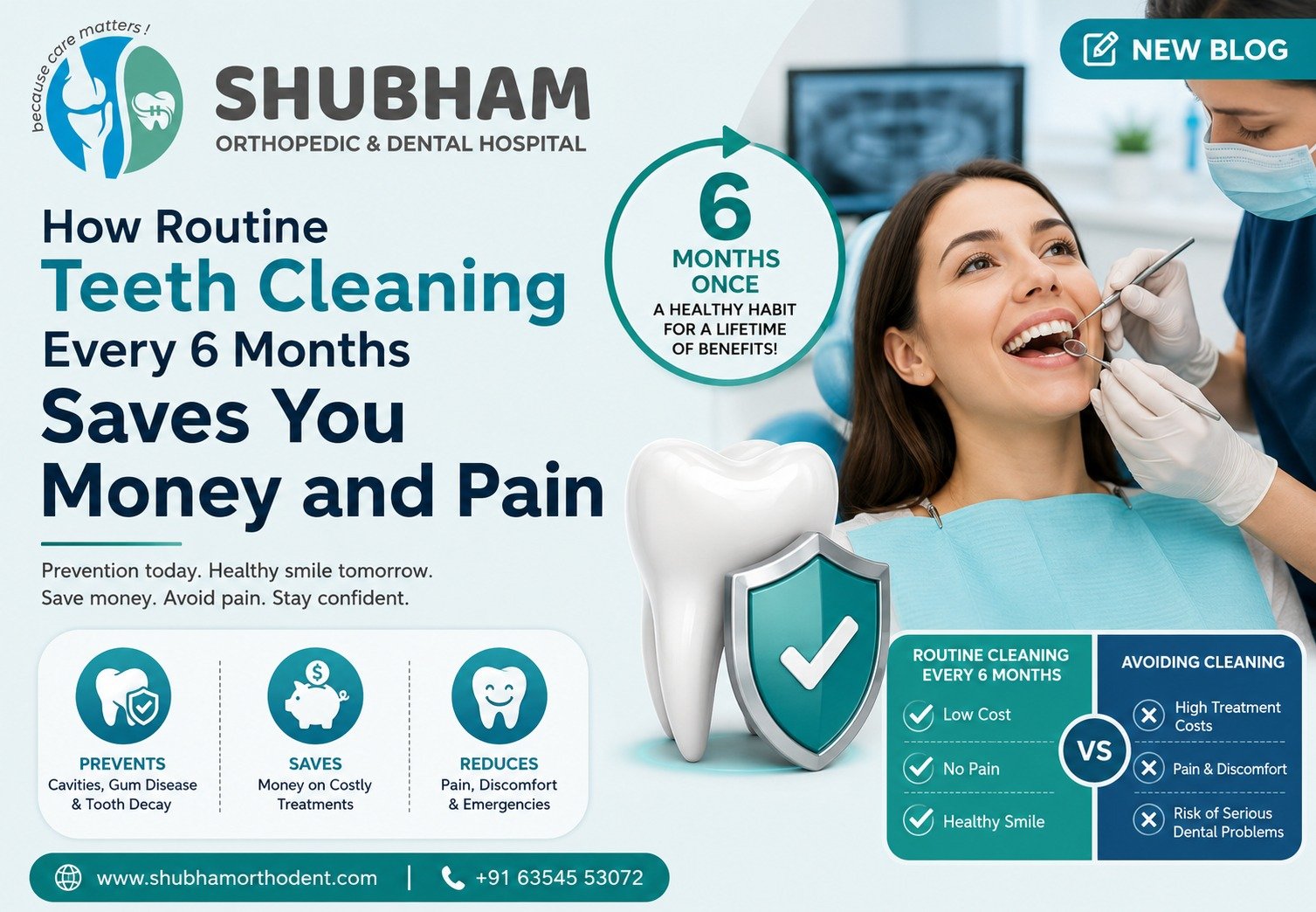
Professional teeth cleaning every 6 months is not just a hygiene recommendation. It is the most financially sensible dental decision a person can make, and it prevents the kind of pain that comes from neglect rather than bad luck.
Dr. Margee Doshi (BDS, MDS Orthodontist) at Shubham Orthopaedic and Dental Hospital, Bhavnagar, explains exactly what happens when you skip, what the real cost difference looks like, and why 6 months is the magic number.
Why Teeth Cleaning Every 6 Months Is the Right Interval
Six months is not an arbitrary number invented by dentists. It is based on the biology of your mouth and the speed at which plaque calcifies into tartar.
Within 24 to 48 hours of brushing, a thin film of bacteria called plaque begins to reform on your tooth surfaces. Plaque is soft and removable with a toothbrush. However, if plaque is not fully removed each day, it begins to absorb minerals from saliva and hardens into tartar, also called calculus, within 10 to 14 days.
Once tartar forms, it cannot be removed by any amount of brushing or flossing at home. It requires professional instruments and clinical skill to remove safely. The longer tartar stays on your teeth, the more it accumulates, the deeper it pushes below the gumline, and the more damage it causes to the bone that holds your teeth in place.
What Happens Inside Your Mouth When You Skip Routine Teeth Cleaning
This is the timeline most patients do not see because it happens slowly and silently inside the gum tissue and bone. Understanding it makes the value of routine cleaning impossible to ignore.
The Silent Progression : What Skipping Looks Like Month by Month
Months 1 to 3
Plaque hardens into tartar. Tartar accumulates at the gumline and in the grooves between teeth. Your brush cannot remove it. Gums begin to show mild inflammation (gingivitis). No pain yet.
Month 4 to 8
Gingivitis deepens. Gums bleed when you brush. Tartar pushes below the gumline. Bacteria colonize the space between the tooth root and the gum pocket. Early bone loss begins. Cavities form in hard-to-clean areas between teeth.
Month 12 to 24
Periodontitis sets in. Pockets deepen around tooth roots. Bone support is measurably reduced. Cavities have spread to the pulp of the tooth, now requiring root canal therapy. Gum surgery may be needed. Tooth loss becomes a real risk.
Year 3 and beyond
Irreversible damage. Significant bone loss cannot be recovered. Multiple teeth may require extraction and replacement with implants or dentures. Total treatment costs can reach Rs. 1,00,000 or more.
What a Routine Teeth Cleaning Every 6 Months Actually Includes
Many patients are surprised to learn how much is included in a standard 6-month cleaning appointment. It is significantly more comprehensive than a basic brushing.
Step-by-step: your professional teeth-cleaning appointment
- Ultrasonic scaling above the gumline : A gentle ultrasonic instrument vibrates at high frequency to break up and flush away tartar deposits from all visible tooth surfaces. This is far more effective and comfortable than hand instruments alone.
- Subgingival scaling (below the gumline) : Fine instruments remove tartar from beneath the gum margin where bacteria cause the most damage. In a regular 6-month patient, this is minimal. In a patient who has waited 2 years, this takes significantly longer and may require local anesthesia.
- Air polishing and stain removal : A fine jet of water, air, and polishing powder removes surface stains from tea, coffee, tobacco, and food. Teeth are left smooth, clean, and noticeably brighter.
- Flossing and interproximal cleaning : Professional flossing cleans between every tooth, reaching areas the ultrasonic scaler cannot access.
- Fluoride treatment if indicated : A fluoride gel or varnish applied to the tooth surfaces helps strengthen enamel and reduce sensitivity after cleaning.
- Full dental examination : Dr. Margee Doshi examines every tooth, the gum tissue, tongue, and soft tissue for early signs of cavities, gum disease, oral cancer, bite problems, and grinding damage. Problems caught here are always smaller, cheaper, and less painful to treat.
What Research Says About Routine Teeth Cleaning Every 6 Months
The recommendation for professional cleaning every 6 months is not just clinical tradition. It is backed by decades of research into the biology of tartar formation and gum disease progression.
A major review published in the National Institutes of Health (NIH) confirmed that regular professional dental cleaning significantly reduces the incidence of periodontitis, reduces overall tooth loss, and is associated with lower systemic inflammation markers, with implications for heart disease and diabetes management in regular dental patients.
- Patients who receive professional cleaning every 6 months have 50 to 60% lower rates of tooth loss compared to patients who visit only when symptomatic.
- Gum disease is directly associated with increased risk of cardiovascular disease, with multiple studies confirming the inflammatory link.
- Diabetic patients with well-maintained gum health demonstrate measurably better blood glucose control, with gum disease making diabetes harder to manage.
- Routine cleaning every 6 months is the most evidence-supported single intervention in preventive dentistry.
Teeth cleaning every 6 months and your overall health
Your mouth is not isolated from the rest of your body. Chronic gum inflammation releases bacteria directly into your bloodstream. These bacteria have been detected in arterial plaques in cardiac patients, in joint fluid in arthritis patients, and in the lungs of patients with respiratory conditions. The 6-month cleaning is not just about teeth. It is a genuine contribution to your systemic health.
Common Myths About Routine Dental Cleaning : Corrected
A significant number of patients skip routine cleaning based on beliefs that are simply not accurate. Here are the most common ones, corrected.
Myth
Cleaning damages or weakens your teeth
Cleaning damages or weakens your teeth
Fact
Ultrasonic scaling removes deposits from the tooth surface. It does not touch or remove any tooth structure. The enamel is not affected in any way.
Ultrasonic scaling removes deposits from the tooth surface. It does not touch or remove any tooth structure. The enamel is not affected in any way.
Myth
My teeth look fine, so I do not need a cleaning
My teeth look fine, so I do not need a cleaning
Fact
Tartar buildup and gum disease primarily occur below the gumline where you cannot see or feel them until significant damage has already occurred.
Tartar buildup and gum disease primarily occur below the gumline where you cannot see or feel them until significant damage has already occurred.
Myth
Cleaning makes your teeth sensitive permanently
Cleaning makes your teeth sensitive permanently
Fact
Mild sensitivity for 24 to 48 hours after cleaning is common, especially if significant tartar was present. It resolves quickly and does not indicate damage.
Mild sensitivity for 24 to 48 hours after cleaning is common, especially if significant tartar was present. It resolves quickly and does not indicate damage.
Myth
I brush well so I do not need professional cleaning
I brush well so I do not need professional cleaning
Fact
Brushing removes soft plaque. Once plaque hardens into tartar (within 10 to 14 days), no toothbrush or floss can remove it. Professional scaling is the only solution.
Brushing removes soft plaque. Once plaque hardens into tartar (within 10 to 14 days), no toothbrush or floss can remove it. Professional scaling is the only solution.
Summary
Tartar forms within 10 to 14 days and cannot be removed by brushing at home. Only professional scaling removes it.
Six months is the clinically validated interval before tartar buildup becomes difficult to manage without discomfort.
A professional cleaning costs Rs. 800 to 2,000. A root canal and crown costs Rs. 9,000 to 27,000. Prevention wins every time.
Gum disease causes no pain in its early stages. By the time you feel it, bone loss has already occurred.
Routine cleaning includes a full examination that catches oral cancer, bite problems, and grinding damage you cannot self-diagnose.
Gum disease is directly linked to heart disease, diabetes, and respiratory conditions. A clean mouth supports your whole body.
Patients who come every 6 months have 50 to 60% lower tooth loss rates compared to patients who visit only when in pain.
Cleaning is not painful for regular patients. Sensitivity lasting 24 to 48 hours is normal and resolves quickly.