
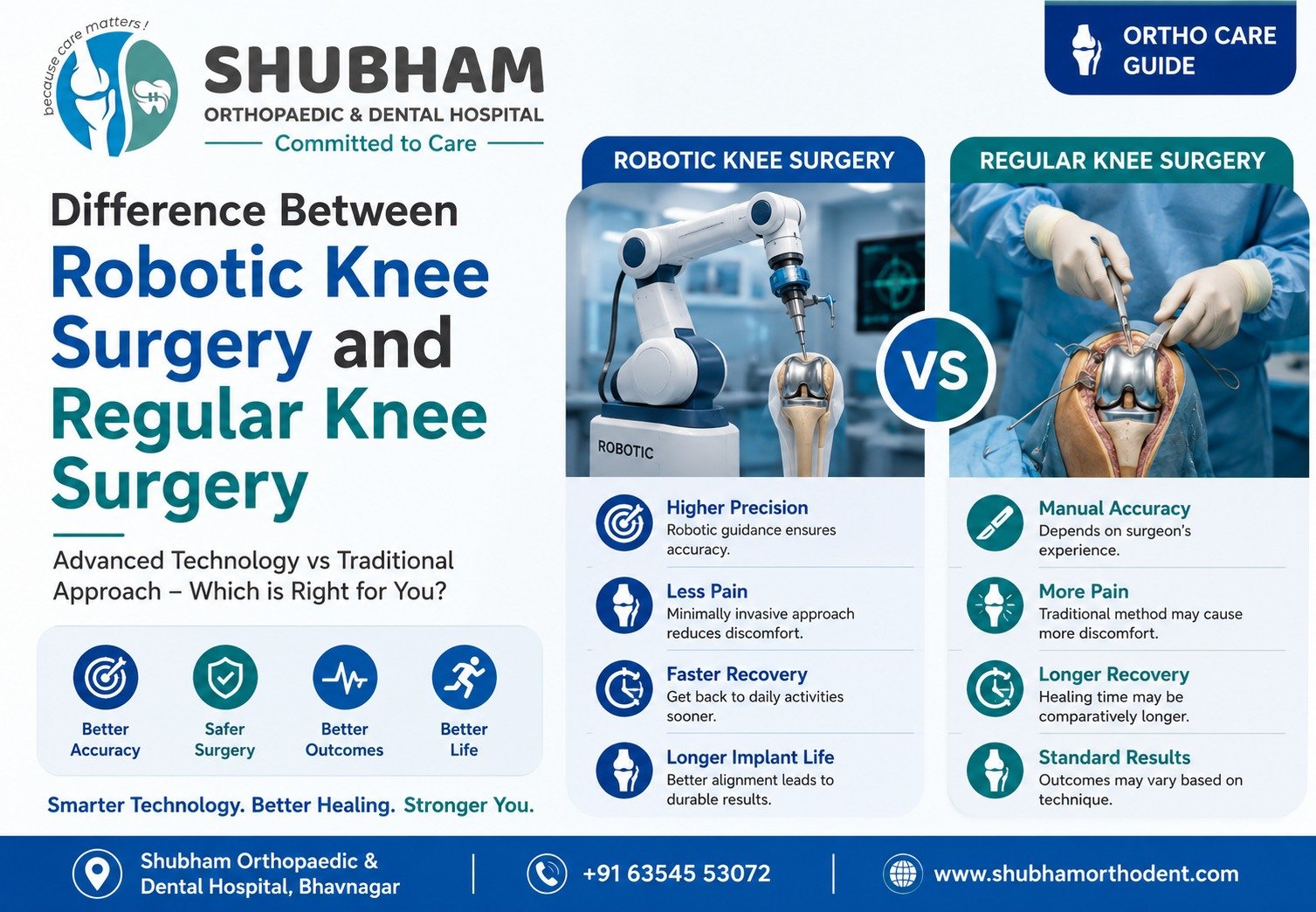
If your doctor has recommended knee replacement surgery, you have probably heard two options mentioned: robotic knee surgery and regular knee surgery. You may have been told one is more accurate, or one is cheaper, or one requires less recovery time. The challenge is that most sources either oversell the robotic option or dismiss it entirely, leaving patients without a clear, honest comparison.
This guide was written by Dr. Kushal Doshi, orthopedic and joint replacement surgeon at Shubham Orthopedic and Dental Hospital, to give you a complete, evidence-based understanding of the difference between robotic knee surgery and regular knee surgery, covering the procedure itself, recovery, cost, and who genuinely benefits from each option.
What Is Knee Replacement Surgery?
Knee replacement surgery, also known as knee arthroplasty, involves removing the damaged cartilage and bone surfaces of the knee joint and replacing them with artificial components, an implant made of metal alloys, high-grade plastics, and polymers that recreate the smooth, pain-free movement of a healthy knee.
It is recommended when:
- Chronic knee pain from osteoarthritis, rheumatoid arthritis, or injury significantly limits daily activities
- The knee is stiff and limits your range of motion
- Medications, physiotherapy, and injections no longer provide adequate relief
- The knee is visibly deformed or severely misaligned
According to a comprehensive meta-analysis published in the peer-reviewed journal Cureus (2023), robotic-assisted knee surgery showed significantly better hip-knee-ankle alignment and Oxford Knee Scores compared to conventional surgery, but both methods delivered broadly similar outcomes for pain and range of motion at the short-to-midterm mark. The key difference is precision and personalisation, not short-term pain relief.
How Regular Knee Surgery Works
Regular knee surgery, also known as conventional or traditional knee replacement, has been performed for over five decades and has helped millions of patients worldwide regain mobility and live pain-free. It remains a highly effective and widely available procedure.
The Conventional Knee Replacement Process
- Pre-surgical planning: The surgeon uses X-rays and physical measurements to plan bone cuts and implant sizing
- Manual cutting guides: Instruments are attached to the leg bone during surgery to guide the direction and angle of cuts
- Surgeon-guided precision: The surgeon makes bone cuts based on guides and their own training, experience, and judgment
- Implant placement: The implant is fixed after the surgeon assesses alignment visually and through mechanical checks
- Closure: The wound is closed and post-operative rehabilitation begins
Robotic Knee Surgery
- 3D pre-surgical planning using CT scan
- Real-time robotic arm guidance during surgery
- Sub-millimetre accuracy in bone cuts
- Implant placement adjusted to patient’s unique anatomy
- Less tissue damage, smaller operative field
- Data-driven intraoperative feedback
Regular Knee Surgery
- Planning based on X-rays and measurements
- Manual cutting guides during surgery
- Alignment dependent on surgeon’s skill
- Standard implant sizing protocol
- Well-established, widely available
- Lower cost, faster surgical setup
How Robotic Knee Surgery Works
Robotic knee surgery does not mean a robot performs your surgery. The surgeon remains in complete control throughout. The robotic system is a precision tool that assists the surgeon in planning and executing the procedure with a level of accuracy that is difficult to achieve manually.
The Robotic-Assisted Knee Replacement Process
- Pre-operative CT scan: A detailed CT scan of your knee is taken before surgery. This is used to create a three-dimensional digital model of your joint, bones, and anatomy.
- Virtual surgery planning: Dr. Kushal uses this 3D model to plan the exact size, positioning, and angle of the implant matched precisely to your individual anatomy before a single incision is made.
- Robotic arm guidance in the theater: During surgery, the robotic arm restricts movement to a pre-defined safe zone, preventing the surgeon from making cuts outside the planned boundaries.
- Real-time data and adjustments: The system provides live feedback on how the knee is moving and functioning, allowing the plan to be adjusted if the live anatomy differs slightly from the CT model.
- Implant placement: The implant is placed within the precisely prepared surfaces, with the robotic arm ensuring it matches the pre-planned position to within fractions of a millimetre.
Key Differences Between Robotic Knee Surgery and Regular Knee Surgery
Here is a detailed look at every meaningful difference between robotic and conventional knee replacement surgery:
1. Precision and Alignment
Robotic
Sub-millimeter accuracy in bone cuts. Studies have shown that robotic-assisted surgery has a better hip-knee-ankle angle than conventional surgery, which is a measure of how well the knee is aligned. Fewer alignment outliers compared to conventional methods, meaning implants sit in a more consistent anatomical position.
Regular
Alignment depends on the surgeon’s skill, manual guides, and intraoperative judgment. Experienced surgeons achieve excellent results. However, manual cuts may lead to slight misalignment in some cases, which can affect implant longevity over the long term.
2. Pre-Surgical Planning
Robotic
A CT scan creates a full 3D model of your knee before surgery. The surgeon plans the exact implant size, angle, and position in a virtual environment, allowing them to anticipate challenges before entering the theater. Every patient has a unique surgical plan.
Regular
Planning based on X-rays, physical measurements, and template guides. Effective and time-tested, but does not create a patient-specific 3D plan. Implant sizing is based on standard anatomical templates rather than the individual’s exact bone geometry.
3. Tissue Preservation and Incision
Robotic
Robotic-assisted surgeries are generally less invasive compared to traditional techniques. The smaller incisions result in less tissue damage, which can lead to a faster recovery and less postoperative pain. The robotic arm minimizes unnecessary movement in surrounding soft tissues.
Regular
Standard incisions provide the surgeon full visibility of the operative field. Slightly more surrounding tissue is disturbed to accommodate manual instrumentation. The procedure remains very effective, but recovery may take marginally longer in some patients.
4. Recovery Time
Robotic
Less tissue trauma typically translates to less post-operative pain and swelling in the first few days. Many robotic knee replacement patients begin walking on the same day or the day after surgery. Return to daily activities averages 4 to 6 weeks, with full recovery by 3 to 4 months.
Regular
Recovery follows a similar broad timeline, with most patients walking within 1 to 2 days of surgery. Longer recovery compared to robotic surgery can occur due to more tissue damage, though outcomes vary significantly by patient age, weight, and fitness.
5. Implant Longevity
Robotic
Studies have shown that patients who undergo robotic knee replacement surgery experience less wear and tear on the implant, reducing the likelihood of needing revision surgery in the future. Better alignment reduces uneven stress on the implant surfaces.
Regular
Conventional knee replacements have a well-documented survival rate of approximately 95% at 10 years and 90% at 15 years when performed by an experienced surgeon. Longevity depends heavily on alignment and the patient’s activity levels.
6. Cost
Robotic
Significantly more expensive due to the cost of the robotic system, CT scanning, specialized disposables, and longer operative time during initial adoption. In India, robotic knee replacement adds approximately ₹50,000 to ₹1,50,000 to the overall cost compared to conventional surgery.
Regular
Regular knee surgery is more affordable than robotic surgery and widely available at most orthopedic centers. Covered fully under most health insurance and Mediclaim policies. An experienced surgeon with conventional technique delivers excellent outcomes at a lower overall cost.
Who Should Choose Robotic Knee Surgery and Who Should Choose Regular?
Consider Robotic Knee Surgery if you are :
- Younger and physically active people have better long-term alignment, extending implant life
- Significantly overweight precision reduces stress on the implant and surrounding bone
- Have complex knee anatomy or deformity that requires customised planning
- Having a revision surgery (replacing a failed earlier implant)
- Have asymmetric leg alignment or prior leg fracture history
- Willing to invest more upfront for potentially longer implant life
Regular knee surgery is a strong choice if you are :
- A standard case of knee osteoarthritis with normal anatomy
- Cost-conscious or relying on insurance coverage
- Treated by a highly experienced joint replacement surgeon
- Older and less physically active after surgery
- Operating at a centre without robotic technology nearby
- Comfortable with decades of proven surgical outcomes data
Frequently Asked Questions
Q: Is robotic knee surgery safer than regular knee surgery?
Both are safe procedures when performed by a qualified surgeon in a well-equipped hospital. Head-to-head studies show that robotic knee replacement improves radiographic precision over traditional knee replacement, while pain, function, and complications are generally similar. Robotic surgery reduces the risk of misalignment, which can lower the chance of long-term complications like implant wear or the need for revision surgery.
Q: Is robotic knee surgery painful?
Knee replacement surgery involves pain management with anesthesia and postoperative medication regardless of which technique is used. Due to less tissue disruption in robotic surgery, many patients report lower pain levels in the first few days after surgery compared to the conventional technique. Both methods require physiotherapy during recovery.
Q: How long does robotic knee surgery take compared to regular knee surgery?
Operative time is typically longer during robotic knee surgery, particularly during the adoption phase when surgeons are building experience with the system. As the surgeon becomes more proficient, operating times approach those of conventional surgery. On average, robotic surgery may add 15 to 30 minutes to the procedure.
Q: Can both knees be replaced at the same time?
Simultaneous bilateral knee replacement (both knees at once) is possible but is generally recommended only for younger, healthier patients without significant cardiac or pulmonary risk. Dr. Kushal evaluates each patient’s fitness and risk profile individually before recommending single or bilateral procedures.
Q: Does health insurance cover robotic knee surgery in India?
Most standard health insurance and Medicare/Medicaid policies cover knee replacement surgery. However, coverage for the additional cost of the robotic system component varies by policy. We recommend checking with your insurance provider before surgery. Shubham Orthopaedic and Dental Hospital’s team assists patients with insurance documentation and pre-authorization.
Q: How long do knee replacements last?
A well-aligned knee replacement performed by an experienced surgeon lasts approximately 15 to 25 years. Robotic surgery is expected to extend implant longevity further due to better alignment, though long-term data beyond 10 years is still being gathered for robotic systems. Longevity also depends strongly on maintaining healthy body weight and following rehabilitation guidelines.