ByDr. Kushal Doshi, MS DNB OrthoPublishedMay 11, 2026 Reading time:9 min Shubham Hospital, Bhavnagar
Your shoulder is one of the most complex and mobile joints in your body. When arthritis, a severe rotator cuff tear, or injury damages it beyond repair, even the simplest tasks like reaching a shelf, combing your hair, or sleeping through the night become painful ordeals.
Shoulder replacement surgery, also called shoulder arthroplasty, has transformed the lives of millions of patients worldwide. Yet many people remain unaware of just how effective and long-lasting the results can be.
In this guide, Dr. Kushal Doshi (MS, DNB Ortho) at Shubham Orthopaedic Hospital, Bhavnagar walks you through every significant benefit of shoulder replacement surgery, who qualifies, what recovery looks like, and what outcomes you can realistically expect.
| 95% Patient satisfaction rate globally |
15+ Years average implant lifespan |
3-6 Months to full recovery |
90% Report significant pain relief |
|---|
What Is Shoulder Replacement Surgery?
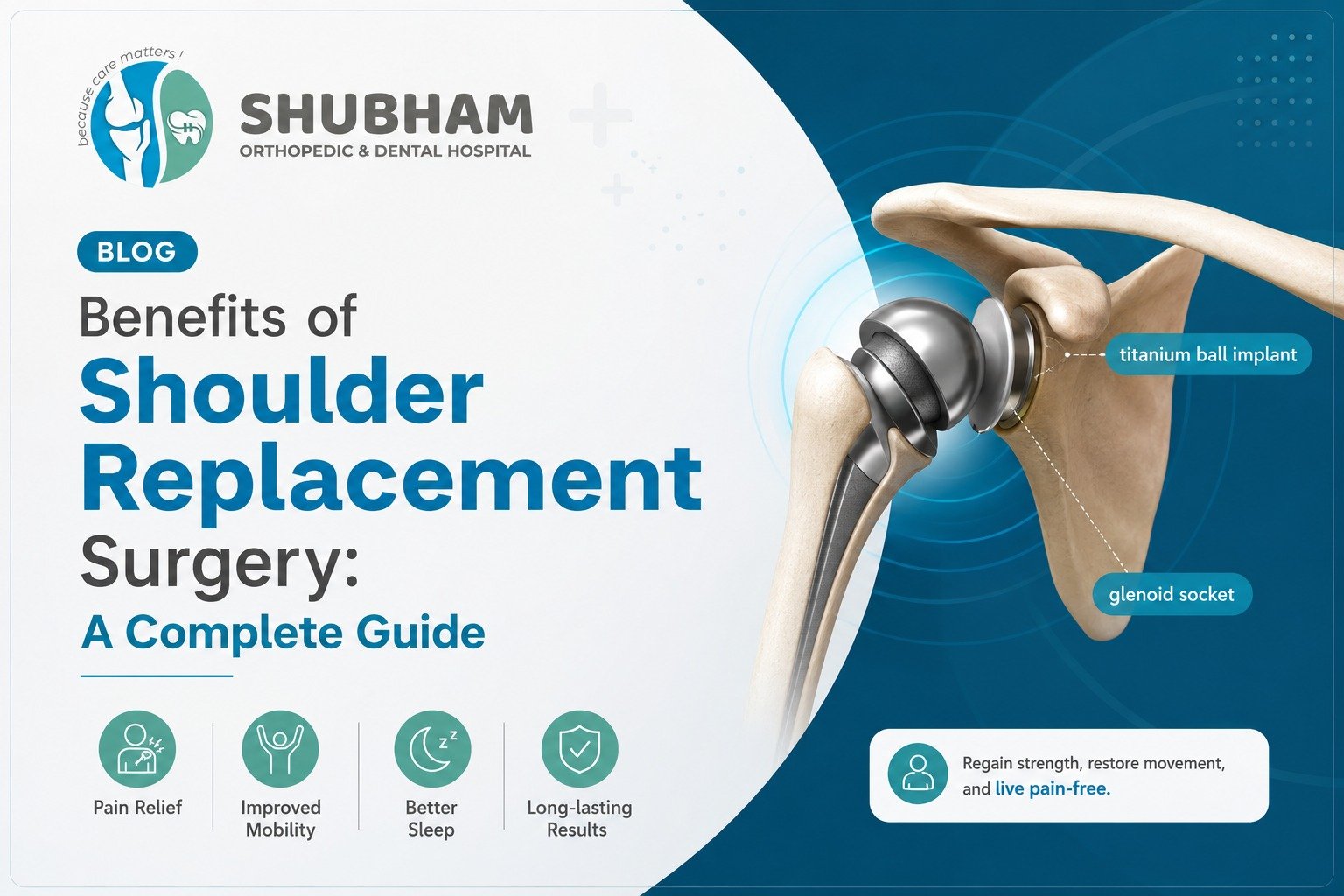
- Total shoulder replacement: Both the ball (humeral head) and socket (glenoid) are replaced. Ideal for patients with arthritis and an intact rotator cuff.
- Reverse shoulder replacement: The ball and socket are switched. Designed for patients with severe rotator cuff damage. This is now the most commonly performed type.
- Partial shoulder replacement (hemiarthroplasty): Only the ball portion is replaced. Used when the socket remains intact and healthy.
“Many of my patients come to me having lived with shoulder pain for years, thinking surgery is a last resort with uncertain outcomes. What surprises them is how dramatically their life improves within just three to four months. Shoulder replacement surgery, when done at the right time, is one of the most rewarding procedures in orthopaedics.”
Dr. Kushal Doshi
MS, DNB Ortho – Orthopaedic Surgeon, Shubham Hospital, Bhavnagar
Top Benefits of Shoulder Replacement Surgery
Dramatic and Lasting Pain Relief
Restored Range of Motion
Better Sleep Quality
Long-Term Implant Durability
Return to Daily Independence
Improved Mental Health
Return to Low-Impact Activities
Reduced Dependency on Medications
How Shoulder Replacement Surgery Eliminates Chronic Shoulder Pain
Shoulder replacement surgery directly addresses the root cause. The damaged joint surfaces are removed and replaced with smooth metal and polyethylene components that replicate natural shoulder mechanics. The result is a joint that moves without the grinding, inflammation, and friction that caused pain.
Suffering from Chronic Shoulder Pain in Bhavnagar?
Dr. Kushal Doshi (MS, DNB Ortho) will evaluate your condition and help you decide if shoulder replacement surgery is the right path for you. No pressure, just expert guidance.
Book a Consultation
Shoulder Replacement Surgery Benefits for Mobility and Function
What shoulder replacement surgery restores
- Forward flexion : The ability to raise your arm in front of you, essential for reaching shelves, steering a vehicle, and most overhead tasks.
- Abduction : Raising the arm sideways, needed for tasks like dressing, carrying bags, and personal hygiene.
- External and internal rotation : Rotating the arm to comb hair, tuck in a shirt, or fasten a seatbelt.
- Grip and lifting strength: As shoulder mechanics normalize, grip and arm strength improve steadily over 3 to 6 months of physiotherapy.
Who Are the Best Candidates for Shoulder Replacement Surgery?
Common conditions that benefit from shoulder replacement surgery
Shoulder Replacement Surgery Recovery : What to Expect
Week-by-week recovery after shoulder replacement surgery
Week 1 to 2
Hospital and Home Rest Phase
Week 3 to 6
Passive Motion Phase
Week 6 to 12
Active Motion Phase
Month 3 to 6
Strengthening and Return to Activity
Month 6 and Beyond
Full Functional Recovery
Are There Risks? An Honest Assessment
- Infection : Less than 1% in clean surgical environments with proper antibiotic protocol.
- Implant loosening : Rare in the first decade. More relevant after 15 to 20 years.
- Nerve injury : Temporary numbness or weakness can occur and usually resolves over weeks to months.
- Instability or dislocation : More common in the first few weeks if rehabilitation instructions are not followed carefully.
- Stiffness : Can develop if physiotherapy is delayed or skipped. Consistent adherence to the rehab program greatly reduces this risk.
How Shoulder Replacement Surgery Improves Overall Quality of Life
The benefits of shoulder replacement surgery extend far beyond the physical. Living with chronic shoulder pain affects every dimension of a person’s life.
Life improvements patients report after shoulder replacement surgery
- Restored independence: Ability to bathe, dress, and cook without help from family members.
- Better sleep: Night pain is one of the most debilitating aspects of shoulder arthritis. Its elimination alone transforms patients’ wellbeing.
- Return to work: Many patients return to desk-based work within 6 to 8 weeks and to physical work within 4 to 6 months.
- Social reconnection: Patients who withdrew from social activities due to pain return to family events, outings, and hobbies.
- Reduced medication burden: Long-term NSAID use carries its own health risks. Eliminating the need for these medications is a significant health gain.
- Improved mental health: Studies consistently link chronic pain reduction to improved mood, lower rates of depression, and better cognitive function.
Summary : Key Benefits of Shoulder Replacement Surgery
Significant and long-lasting relief from chronic shoulder pain in over 90% of patients.
Restored range of motion including lifting, reaching overhead, and arm rotation.
Elimination of night pain, resulting in dramatic improvement in sleep quality.
Return to daily independence without relying on family members for basic tasks.
Implant durability of 15 to 20 years with modern prosthesis technology.
Reduced or eliminated dependency on pain medications and injections.
Return to low-impact activities like swimming, yoga, and cycling.
Significant improvement in mental health, mood, and social participation.