Every parent watches their baby’s first tooth appear with a mixture of delight and anxiety. What comes after that tiny first tooth is a complex, precisely timed biological process that lasts until your child is a teenager. Understanding how your child’s jaw and teeth develop helps you protect their smile at every stage.
Problems in child jaw and teeth development rarely announce themselves loudly. They accumulate quietly over months and years. The parents who catch them early are the ones who know what to look for and when to bring their child to a dentist.
In this complete guide, Dr. Margee Doshi (BDS, MDS Orthodontist) at Shubham Orthopaedic and Dental Hospital, Bhavnagar, explains every milestone in child jaw and teeth development, what to watch for at each stage, and how to protect your child’s smile from their first tooth to their teens.
Why Child Jaw and Teeth Development Matters
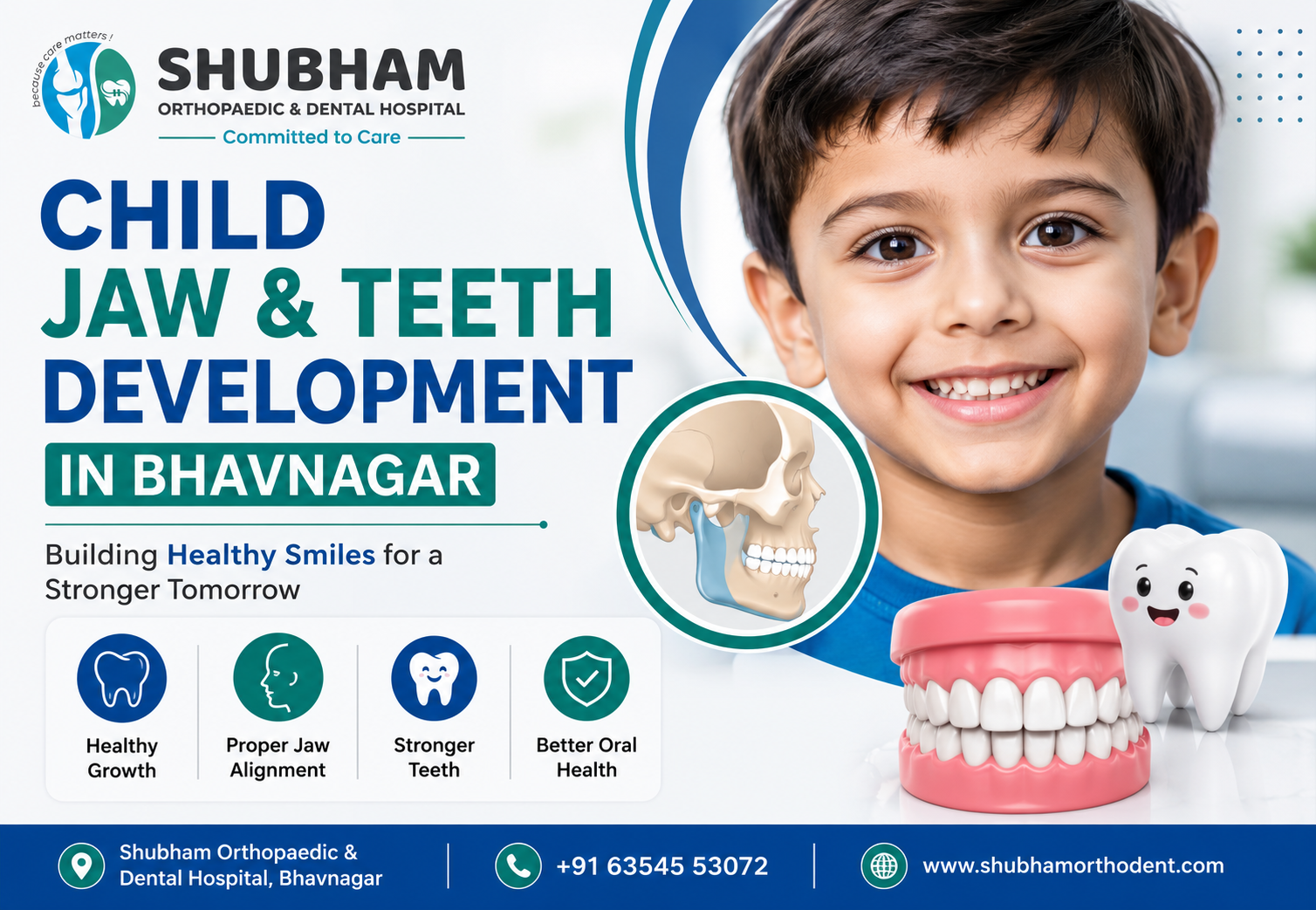
The way your child’s jaw and teeth develop does not just affect how they look. It shapes how they chew, breathe, speak, and sleep. The jaw is the structural foundation of the face. When it grows correctly, teeth align naturally, airways open fully, and facial proportions develop harmoniously. When jaw development is disrupted by habits, genetics, or early tooth loss, the effects ripple through every connected system.
Child jaw and teeth development in Bhavnagar is influenced by the same factors seen globally: diet texture, oral habits, genetics, breathing patterns, and early dental care. Understanding these factors gives parents the tools to actively support healthy development rather than simply waiting and hoping.
Stages of Child Jaw and Teeth Development
Child jaw and teeth development unfolds in six distinct stages. Each stage has its own milestones, its own risks, and its own opportunities for intervention if something is going off track.
0-6 months
Stage 1
Pre-Eruption: Tooth Buds Under the Gum
All 20 primary teeth are already formed as buds within the gum tissue at birth. The jaw grows rapidly during the first 6 months of life. Breastfeeding supports healthy jaw development by requiring wide jaw movement, while bottle feeding with a narrow teat may encourage a narrower jaw arch over time.
6-24 months
Stage 2
First Teeth Erupt: Lower Front Teeth First
The lower central incisors typically appear first between 6 and 10 months. Upper central incisors follow at 8 to 12 months. By 24 months, most children have 16 of their 20 primary teeth. Teething discomfort, drooling, and mild irritability are normal. A fever above 38.5°C during teething is not caused by teething and requires medical evaluation.
2-3 years
Stage 3
Complete Primary Dentition: All 20 Baby Teeth Present
By age 3, a full set of 20 primary teeth is present. These teeth hold space for the permanent teeth developing below them in the jawbone. Primary teeth are not just temporary placeholders; they are critical guides for permanent tooth eruption. Early loss of primary teeth due to decay or injury can cause permanent teeth to erupt in the wrong position.
5-7 years
Stage 4
Mixed Dentition Begins: First Permanent Molars and Front Teeth
The six-year molar the first permanent molar, erupts without replacing any baby tooth. It erupts silently at the back of the mouth, and many parents miss it entirely. This molar is the cornerstone of the permanent bite, and establishing its correct position is critical. Simultaneously, the lower front baby teeth loosen, and permanent incisors begin to appear.
7-11 years
Stage 5
Active Mixed Phase: Baby Teeth Falling, Permanent Teeth Arriving
The mixed dentition phase is the most active and visible period of child jaw and teeth development. Baby teeth fall in sequence, and permanent teeth replace them. The jaw is growing rapidly during this period and is highly responsive to orthodontic guidance. Space maintainers may be needed if a baby tooth is lost prematurely. This is the ideal window for early orthodontic screening.
12-13 years
Stage 6
Full Permanent Dentition: The Final Smile Forms
By age 12 to 13, all 28 permanent teeth (excluding wisdom teeth) have typically erupted. The jaw has completed approximately 80% of its growth. Any alignment or jaw relationship problems are now clearly visible, and if orthodontic treatment has not begun, it should be started promptly before remaining jaw growth is exhausted. Wisdom teeth will appear between age 17 and 25.
How the Child's Jaw Develops and Why It Matters
The jaw is not a static bone. It grows and remodels continuously from birth through the teenage years. Understanding how a child’s jaw develops helps parents recognise when growth is proceeding normally and when it is being compromised.
Infant JawBirth to Age 3
The infant jaw is small and recessed. Breastfeeding and normal jaw use stimulate rapid growth. The lower jaw grows forward and downward significantly in the first 3 years. Diet texture plays an important role; soft, pureed food for too long can slow the jaw growth stimulus that comes from chewing. |
Growing Child JawAge 4 to Age 11
The jaw grows most rapidly between ages 4 and 11 as permanent teeth develop within it. Oral habits like thumb sucking, mouth breathing, and tongue thrusting can narrow the upper jaw arch and cause the upper front teeth to protrude. This is the most important intervention window for jaw expansion if needed. |
Adolescent JawAge 12 to 18
The jaw reaches approximately 90 to 95% of its final size during adolescence. Orthodontic treatment is highly effective during this phase because remaining jaw growth can be harnessed to correct alignment. After the growth plates fuse in the late teens, correction of jaw relationships requires surgery rather than braces alone. |
What Disrupts Normal Child Jaw and Teeth Development?
- Thumb sucking and pacifier use beyond age 4: Continuous pressure from fingers or pacifiers pushes upper front teeth forward and narrows the upper jaw arch, creating the classic “buck teeth” appearance.
- Mouth breathing: Chronic nasal congestion due to adenoids, tonsils, or allergies forces children to breathe through the mouth. Mouth breathing changes the resting position of the tongue and jaw, narrowing the upper arch over time and causing the lower jaw to grow in a less favourable direction.
- Premature loss of baby teeth: When a primary tooth is lost early due to decay or trauma, adjacent teeth drift into the space. This blocks the eruption path of the permanent tooth waiting below, causing crowding or impaction.
- Tongue thrusting: A swallowing pattern where the tongue pushes forward against the front teeth prevents the upper and lower teeth from coming together correctly.
- Diet lacking hard textures: A diet of entirely soft foods reduces the chewing stimulus required for jaw bone growth and development.
- Genetics: Jaw size and tooth size mismatches, jaw relationship discrepancies (overbite, underbite), and tooth spacing patterns are often inherited.
For parents concerned specifically about orthodontic treatment timing for their child, our Paediatric Dentistry service at Shubham Hospital Bhavnagar covers the full range of child dental care from the first visit through to orthodontic planning. For information on how to maintain your child’s dental health between visits.
How to Support Healthy Child Jaw and Teeth Development at Home
Parents play a direct and significant role in the quality of their child’s jaw and teeth development through daily habits and dietary choices.
Daily Habits That Support Child Jaw and Teeth Development
Start Brushing at the First ToothUse a rice-grain amount of fluoride toothpaste as soon as the first tooth appears. Brush twice daily, morning and night. Parents should assist with brushing until the child is 7 to 8 years old to ensure complete cleaning. |
Introduce Textured Foods EarlyMove beyond pureed foods from 6 months onwards. Chewing hard and fibrous foods including carrots, apples, and roti provides the mechanical stimulus the jaw needs to grow optimally. Exclusively soft diets during key growth periods reduce jaw growth stimulus. |
Stop Thumb Sucking by Age 4Gently discourage thumb sucking and pacifier use from age 3. If the habit persists beyond age 4, bring your child to Dr. Margee Doshi for a habit-breaking appliance and counselling before jaw narrowing becomes established. |
Limit Sugar and Sugary DrinksEarly childhood cavities destroy primary teeth before they can guide permanent teeth into position. Avoid giving juice or milk in a bottle at bedtime. Limit biscuits and sweet snacks. Every cavity in a primary tooth is a threat to the permanent tooth below it. |
Address Mouth Breathing EarlyIf your child habitually breathes through the mouth, consult both a paediatrician (to check for enlarged adenoids or tonsils) and Dr. Margee Doshi (to assess jaw development impact and begin myofunctional guidance if indicated). |
Six-Monthly Dental VisitsRegular check-ups every 6 months allow Dr. Margee Doshi to monitor jaw width growth, track eruption sequences, apply preventive fluoride, catch cavities when they are tiny, and advise on orthodontic timing before problems become established. |
Summary
Child jaw and teeth development unfolds in 6 stages from birth through age 13, each with specific milestones and risks.
The first dental visit should happen by age 1 or within 6 months of the first tooth appearing.
The six-year molar is the most important permanent tooth and erupts without replacing any baby tooth. Check for it.
Mouth breathing, thumb sucking after age 4, and premature baby tooth loss are the three biggest avoidable risks to jaw development.
The jaw grows most rapidly between ages 4 and 12; this is the window for effective orthodontic guidance.
Early loss of a primary tooth requires a space maintainer within days to prevent permanent tooth crowding.
Textured foods from 6 months onwards provide the chewing stimulus the jaw needs to grow to its genetic potential.
Regular 6-monthly check-ups with Dr. Margee Doshi allow continuous monitoring of child jaw and teeth development in Bhavnagar.