A root canal treatment is a dental procedure that removes infected or damaged soft tissue called pulp from inside a tooth to save the natural tooth and stop pain. It carries a reputation built on experiences from decades ago that no longer reflects what the procedure involves or feels like today. Most patients leave their first root canal appointment genuinely surprised by how straightforward it was.
Understanding what root canal treatment is before you need it removes the anxiety that comes from uncertainty. This guide explains exactly what the procedure involves, what is inside the tooth that needs to be treated, why the treatment becomes necessary, and what patients in Bhavnagar can expect from start to finish.
What Is Root Canal Treatment?
Root canal treatment, also called endodontic treatment or RCT, is a dental procedure that removes infected, inflamed, or dead tissue from inside a tooth, thoroughly cleans and shapes the root canals, and seals the space permanently to prevent bacteria from re-entering.
The name comes from the anatomy of the tooth itself. Each tooth contains narrow channels called root canals that run from the crown of the tooth down through the roots into the jawbone. Inside these canals sits the dental pulp, the soft tissue that gave the tooth life during its development. Root canal treatment addresses problems that originate in this pulp.
What Is Inside a Tooth That Root Canal Treatment Addresses?
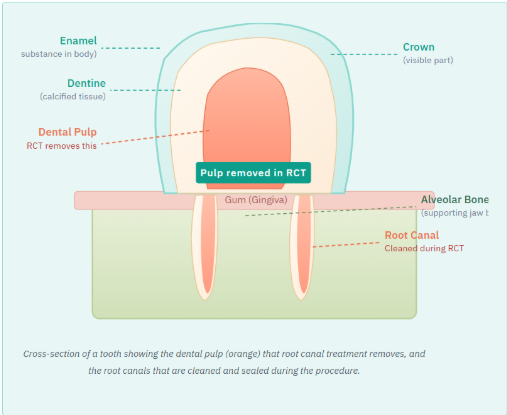
To understand what root canal treatment does, you need to understand the structure of a tooth. Each tooth has three main layers visible in the diagram above:
- Enamel: The outermost layer. The hardest substance in the human body, it protects the tooth from daily wear and acid erosion. Enamel has no nerves and causes no pain when damaged.
- Dentine: The layer beneath enamel. Slightly softer, it contains microscopic tubules that transmit sensation to the pulp. Dentine exposure causes tooth sensitivity to hot, cold, and sweet.
- Dental pulp: The soft core. Contains nerves, blood vessels, and connective tissue. The pulp was essential for tooth formation during development but is not required for a fully formed tooth to function. Root canal treatment removes the pulp when it becomes infected or irreversibly inflamed.
The pulp extends from the pulp chamber in the crown of the tooth down through narrow root canals to the tip of each root. Molars typically have 3 to 4 root canals. Front teeth usually have just 1.
Why Is Root Canal Treatment Needed?
Root canal treatment becomes necessary when the dental pulp is infected or irreversibly inflamed. This happens when bacteria penetrate deep enough into the tooth to reach the pulp chamber.
The Most Common Causes That Make Root Canal Treatment Necessary
- Deep decay: A cavity that has extended past enamel and dentine and reached the pulp. The most common cause of pulp infection and the most preventable.
- Cracked or fractured tooth: A crack extending into the pulp allows bacteria a direct pathway into the sterile pulp environment.
- Repeated dental procedures: A tooth that has had multiple large fillings or restorations may eventually develop pulp irritation that progresses to irreversible inflammation.
- Dental trauma: A blow to the face from an accident, fall, or sports injury can disrupt the blood supply to the pulp even without a visible crack, causing the pulp to die slowly.
- Severe gum disease: In advanced periodontitis, bacteria can track down the root surface into the root tip and infect the pulp from below.
Symptoms That Suggest Root Canal Treatment May Be Needed
- Severe, spontaneous toothache that wakes you at night
- Pain that lingers for more than 30 seconds after a hot or cold stimulus
- Swelling in the gum near a tooth or on the face or jaw
- A pimple-like bump on the gum that may ooze (dental abscess)
- A tooth that has become dark or discoloured compared to adjacent teeth
- Severe pain on biting or touching a specific tooth
- A deep cavity visible in the tooth at the gumline or on X-ray
- A tooth that has no pain but shows bone destruction on X-ray
How Root Canal Treatment Works
Pre-treatment · 15 to 20 minutes
Examination and digital X-ray
A digital X-ray confirms the extent of infection, the number and curvature of root canals, and whether the surrounding bone has been affected. This determines the complexity of treatment and whether single-sitting root canal treatment is possible for your case.
Anaesthesia · 5 minutes
Local anaesthesia: the step that makes it painless
Local anaesthetic is injected near the tooth to completely numb the area. Within 3 to 5 minutes, the tooth and surrounding tissue are fully anaesthetised. You will feel pressure and movement during the procedure but no pain. This is the step that fundamentally changes what root canal treatment feels like compared to its reputation.
Isolation · 2 minutes
Rubber dam placement
A rubber dam isolates the tooth completely from saliva, keeping the canals sterile throughout the procedure. This prevents cross-contamination and protects you from swallowing any irrigation solution.
Core procedure · 20 to 50 minutes
Pulp removal and canal cleaning
An opening is made through the crown of the tooth. Rotary nickel-titanium instruments remove the pulp and precisely shape each root canal from the pulp chamber to the root tip. Antiseptic irrigation solution simultaneously flushes bacteria from the entire canal system. An electronic apex locator measures the exact length of each root canal with precision.
Sealing · 10 to 15 minutes
Canal filling with gutta-percha
Once the canals are clean, dry, and confirmed bacteria-free, they are filled with gutta-percha, a biocompatible rubber-like material combined with sealing cement. This permanently closes the canal system against bacterial re-entry. The access opening is then sealed with a temporary or permanent filling.
Restoration · Separate appointment
Crown placement: completing the treatment
A tooth that has had root canal treatment has had its internal living tissue removed, making it structurally weaker. A dental crown is placed over the tooth to protect it from fracture under normal biting force. This is not optional for back teeth, without a crown, a root-canal-treated molar typically fractures within 1 to 2 years. The crown completes what root canal treatment begins.
Does root canal treatment hurt?
The procedure itself: no. Under effective local anaesthesia, patients feel pressure and the sensation of instruments moving but experience no pain during the actual treatment. Modern anaesthetic agents achieve complete numbness reliably and quickly.
After the anaesthesia wears off, mild to moderate soreness for 2 to 4 days is expected and normal. This is the tissue around the root tip responding to treatment. It is well managed with the prescribed anti-inflammatory medication provided before you leave the clinic. Less than 3% of patients experience significant post-operative pain requiring anything beyond standard medication.
Research published in the National Institutes of Health (NIH) journal confirms that post-operative pain following contemporary root canal treatment is mild to moderate in the majority of patients and resolves within 48 hours in most cases. The study also confirmed that patients’ pre-treatment fear of pain significantly exceeds the actual pain experienced.
Root Canal Treatment in Bhavnagar
Root canal treatment in Bhavnagar at Shubham Orthopaedic and Dental Hospital is performed by Dr. Margee Doshi (BDS, MDS) using digital X-ray guidance, electronic apex locators, rotary NiTi instrumentation, and modern irrigation protocols.
- Single sitting option: Available for suitable cases. Straightforward infections with simple canal anatomy can have the entire procedure completed in one visit of 60 to 90 minutes.
- Cost: Root canal treatment in Bhavnagar at Shubham Hospital starts at Rs. 2,500 for a front tooth and Rs. 4,500 to Rs. 8,000 for a molar depending on the number of root canals.
- Crown after RCT: Ceramic crowns matching the natural tooth shade are fabricated and placed typically 1 to 2 weeks after the final root canal appointment.
- Emergency availability: Dental emergencies, including acute dental abscess are assessed on the same day where possible. Call +91 7433 972 972.
For the complete step-by-step breakdown of the procedure, including sitting requirements and aftercare, read our detailed guide: Root Canal Treatment in Bhavnagar: Complete Guide to Steps, Sittings and Recovery.
What this guide covered
- Root canal treatment removes infected or dead pulp tissue from inside a tooth and seals the root canals permanently.
- The dental pulp containing nerves and blood vessels is what root canal treatment removes. A fully formed tooth does not need to function.
- The procedure is painless under local anaesthesia. Mild soreness for 2 to 4 days after treatment is normal and medication-managed.
- Common causes include deep decay, cracked teeth, dental trauma, and repeated dental procedures on the same tooth.
- The procedure has six steps: X-ray, anaesthesia, isolation, cleaning, sealing, and crown placement.
- Crown placement after root canal treatment is essential; without it, the tooth fractures within 1 to 2 years.
- Root canal treatment saves the natural tooth, preserves the jawbone, and costs significantly less than extraction followed by an implant.
- At Shubham Hospital Bhavnagar, root canal treatment starts at Rs. 2,500. Single-sitting option available for suitable cases.