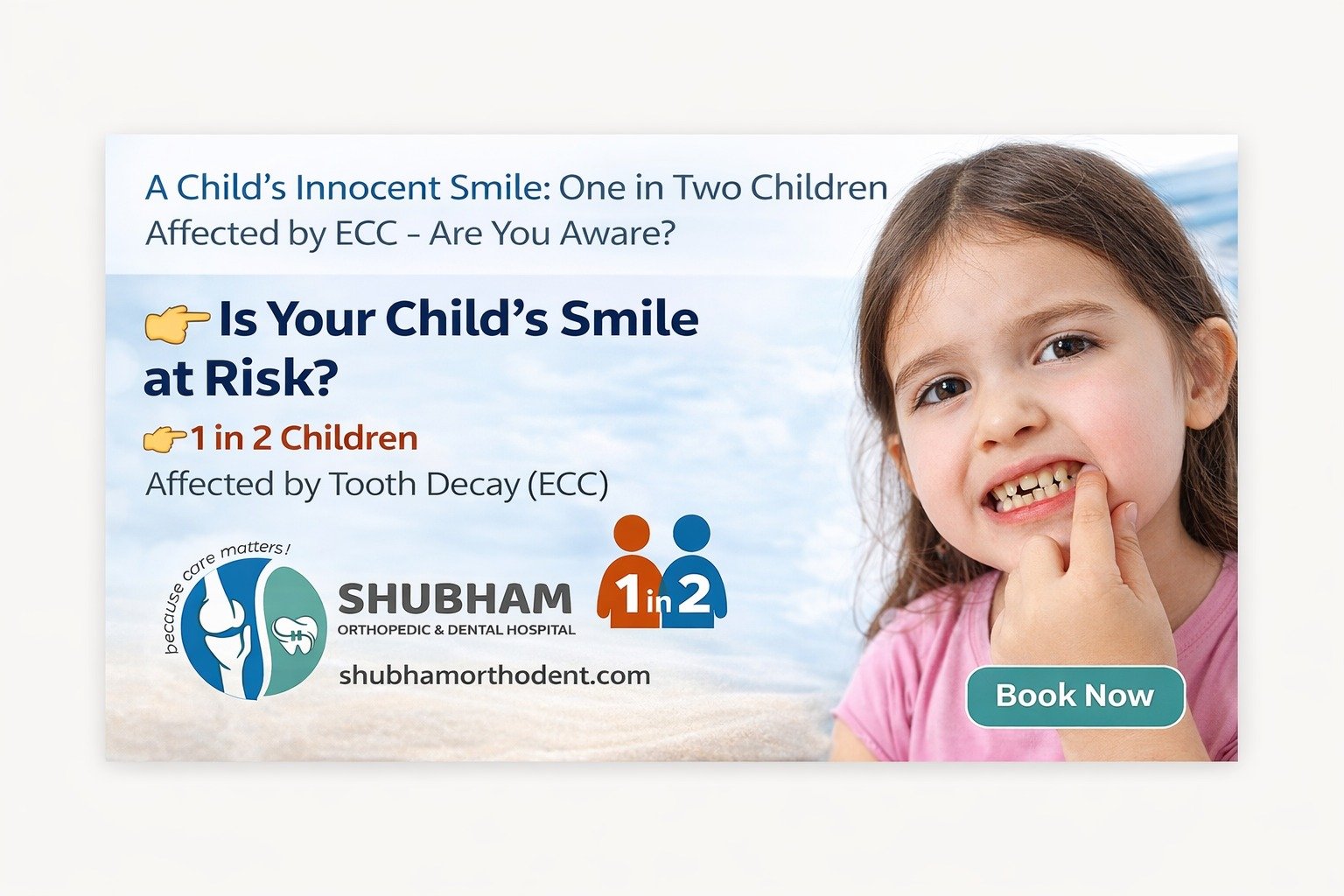
A child’s innocent smile is the greatest joy for any parent. It represents health, happiness, and a bright future. However, beneath that radiant exterior, a silent crisis is brewing in households across India. Did you know that nearly one in every two children suffers from a rapidly worsening condition of tooth decay before they even reach their sixth birthday?
This condition is known as early childhood caries (ECC). While many parents believe that “baby teeth are just going to fall out anyway,” the reality is that neglecting these small teeth can lead to massive health complications in the future. As the best dental hospital in Bhavnagar, Shubham Orthopaedic & Dental Hospital is committed to spreading awareness and providing the expert care your child deserves.
What is Early Childhood Caries (ECC)?
Early Childhood Caries (ECC) is defined as the presence of one or more decayed (non-cavitated or cavitated lesions), missing (due to caries), or filled tooth surfaces in any primary (baby) tooth in a child under the age of six.
Unlike regular cavities in adults, ECC is an aggressive and rapidly spreading condition. It typically starts in the upper front teeth because these are most frequently exposed to milk and sugary fluids during feeding. If not intercepted by a professional at the
best Dental Hospital in Bhavnagar, the decay can jump to the back molars within weeks.
The Startling Reality : ECC Statistics in India
ECC has emerged as a significant public health problem in India. Current studies indicate that the prevalence of ECC ranges from 46.9% to 49.6%.
Key Statistic : Nearly 50% of Indian children under age 6 are affected by ECC. This means if you look at a group of toddlers, every second child is likely battling tooth decay.
These numbers make it clear : ECC is not just a “family problem”; it is a societal challenge that requires urgent parental awareness and professional intervention.
Why Baby Teeth Matter : More Than Just "Temporary"
A common misconception is that baby teeth don’t require expensive care because they are temporary. This couldn’t be further from the truth. Baby teeth serve several critical functions :
- Nutrition : Decayed teeth make chewing painful, leading to poor food intake.
- Speech Development : Teeth are essential for forming sounds and learning to speak clearly.
- Facial Structure : They support the development of facial bones and muscles.
- Space Savers : They hold the exact spot for permanent teeth. If a baby tooth is lost too early to ECC, permanent teeth may grow in crooked (crowding).
The Hidden Signs of ECC You Might Be Missing
ECC develops quietly. Because children under six often cannot articulate specific dental pain, parents must be vigilant. Look for these early warning signs :
- White Plaque-like Spots : Dull white spots near the gum line are the first sign of enamel demineralization.
- Color Changes : Spots that turn yellow, brown, or black indicate advancing decay.
- Sensitivity or Irritability : Does your child cry while eating cold or sweet foods? Do they chew only on one side?
- Bad Breath : Persistent halitosis in a toddler is often a sign of trapped bacteria and decay.
What Causes ECC?
The process is simple but destructive: Bacteria in the mouth react with sugars from food and drinks to produce acid. This acid eats away at the tooth’s outer layer (enamel). In children, the enamel is much thinner than in adults, allowing the acid to reach the soft inner pulp quickly.
Main Risk Factors :
- Frequent consumption of chocolates, biscuits, and packaged juices.
- Baby Bottle Tooth Decay: Allowing a child to fall asleep with a bottle of milk or juice.
- Prolonged bottle feeding beyond the recommended age.
- Skipping the nighttime brushing routine.
The "Vertical Transmission" Fact
PEDIATRIC DENTAL FACT OF THE DAY :
Did you know that tooth decay is actually an infectious disease? An important cause of ECC is
“Vertical Transmission.” This is the direct transfer of cavity-causing bacteria (Streptococcus mutans) from an adult-usually the mother or primary caregiver-to the child.
This happens through innocent daily habits :
- Kissing a child on the mouth.
- Sharing spoons or utensils.
- Cleaning a pacifier with your own mouth before giving it to the baby.
Once these bacteria settle in the child’s mouth, their risk of ECC skyrockets. This is why the oral hygiene of the parents is just as important as the child’s.
Long-Term Effects Beyond the Mouth
The impact of ECC isn’t limited to a single tooth. It can affect the child’s entire growth trajectory :
- Nutritional Deficiencies : Inability to eat a varied diet leads to weight issues.
- Psychological Impact : Children with visible decay may feel self-conscious or shy, affecting their confidence and social development.
- Infection Risk : Severe decay can lead to painful abscesses and systemic infections.
How to Prevent ECC
The good news? ECC is completely preventable. Here is your checklist for a healthy smile :
- Start Early : Clean your baby’s gums with a soft cloth even before teeth appear. As soon as the first tooth pops up, start brushing.
- The “Smear” Rule : For children under 3, use a tiny smear (the size of a grain of rice) of fluoride toothpaste.
- Active Brushing : Children don’t have the manual dexterity to brush effectively until age 7 or 8. Parents must take the lead.
- The Nightly Clean : Never skip brushing at night. Saliva flow decreases during sleep, making teeth more vulnerable to acid.
- Ditch the Bottle at Bedtime : Only water should be in a bottle if a child needs it to fall asleep.
Pediatric Care at Shubham Orthopaedic & Dental Hospital
Choosing the best Dental Hospital in Bhavnagar means choosing a team that understands the unique needs of little patients. At Shubham Orthopaedic & Dental Hospital, we offer :
- Expert Care by Dr. Margee Doshi : Specialized in gentle, kid-friendly dental procedures.
- Preventive Fluoride Applications : To strengthen young enamel against acid attacks.
- Pit and Fissure Sealants : A protective coating for back teeth to prevent food from getting stuck.
- Parent Education : We teach you the right techniques to keep your child’s mouth healthy at home.
Frequently Asked Questions (FAQs)
Summary
Early Childhood Caries is a silent epidemic affecting nearly 50% of our children. However, with timely identification, proper hygiene, and awareness of “vertical transmission,” your child can grow up with a fearless and confident smile. Don’t wait for your child to complain of pain-by then, the decay is already deep.