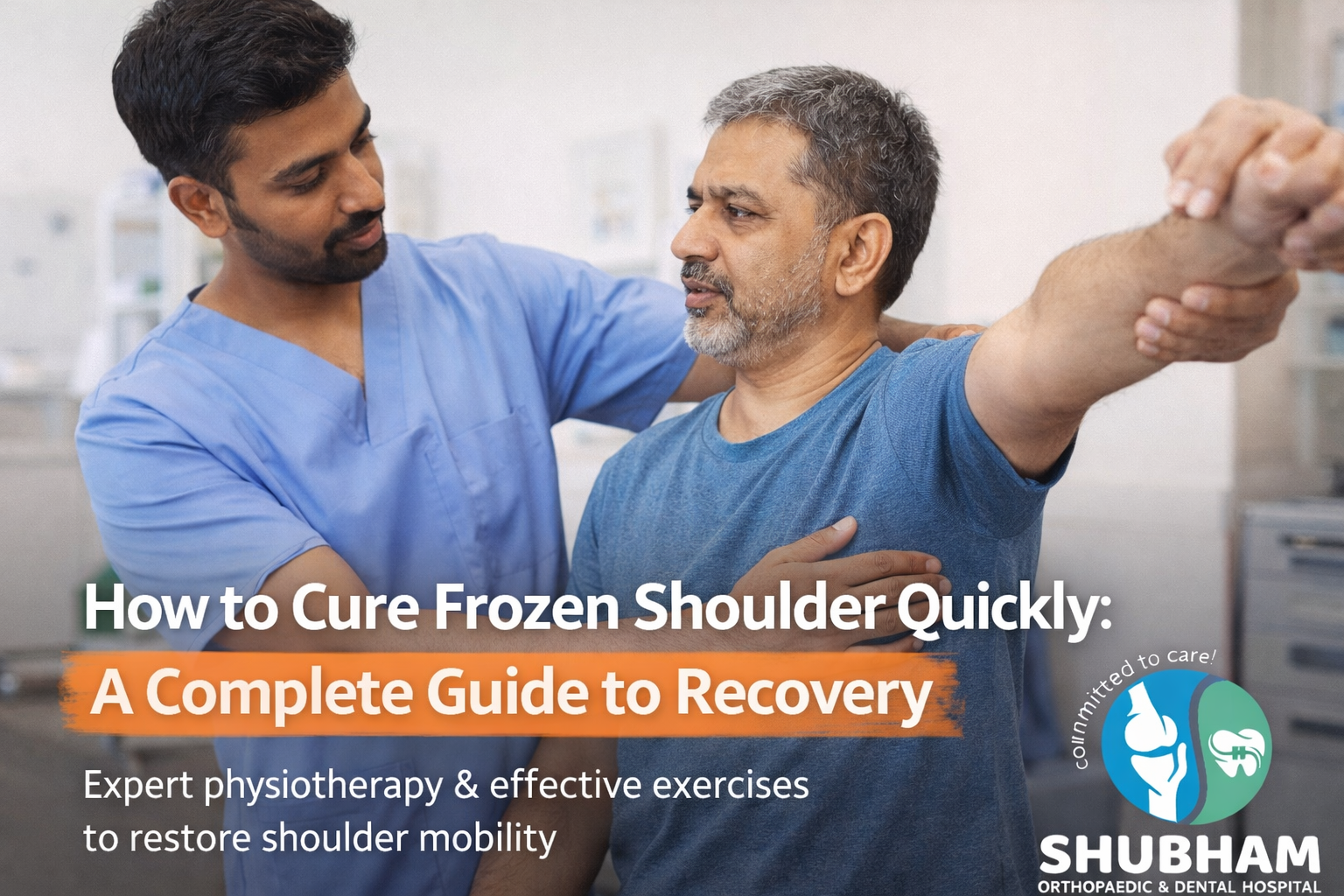
If you have ever woken up with a shoulder so stiff that reaching for a coffee mug feels like a marathon, you might be experiencing adhesive capsulitis, commonly known as a Frozen Shoulder. At Shubham Orthopaedic & Dental Hospital, the Best Orthopaedic Hospital in Bhavnagar, we see hundreds of patients struggling with this debilitating condition.
The good news? While it can be a long journey, you don’t have to suffer indefinitely. This guide explores how to cure frozen shoulders using the latest medical insights and physiotherapy techniques.
The good news? While it can be a long journey, you don’t have to suffer indefinitely. This guide explores how to cure frozen shoulders using the latest medical insights and physiotherapy techniques.
What Is Frozen Shoulder?
Frozen shoulder is a condition characterized by stiffness and pain in the shoulder joint. It occurs when the strong connective tissue surrounding the shoulder joint (the shoulder capsule) thickens and becomes tight, making it difficult for the humerus (upper arm bone) to move freely in the socket.
Frozen Shoulder Causes & Reason
Understanding the reason for frozen shoulders is the first step toward effective treatment. It rarely happens without an underlying trigger :
- Injury or Trauma : A previous fracture or rotator cuff tear can lead to inflammation and subsequent “freezing.”
- Diabetes & Thyroid Disorders : People with diabetes are up to 20% more likely to develop this condition due to the way sugar molecules affect collagen in the joints.
- Post-Surgery Stiffness : Often occurs after breast surgery or heart surgery where arm movement is restricted.
- Long-term Immobility : Keeping the arm still for long periods (e.g., in a sling) is a primary frozen shoulder cause.
- Age and Risk Factors : It is most common in adults aged 40 to 60, and more prevalent in women than men.
Frozen Shoulder Symptoms
How do you know if it’s just a strain or a true frozen shoulder? Look for these frozen shoulder symptoms :
- Dull, Aching Pain : Usually located in the outer shoulder area and sometimes the upper arm.
- Night Pain : The pain often worsens at night, making it difficult to sleep on the affected side.
- Reduced Range of Motion : You find it impossible to reach behind your back or lift your arm above your head.
- The “Clunk” Feeling : A sensation of the joint getting “stuck” during specific movements.
The 4 Stages of Frozen Shoulder
Recovery depends on which of the 4 stages of frozen shoulder you are currently in :
- Pre-freezing (1-3 months) : Sharp pain with movement; often mistaken for a minor strain.
- Freezing (3-9 months) : Pain increases, and the shoulder loses range of motion. This is when most patients seek a frozen shoulder specialist.
- Frozen (9-14 months) : Pain may actually decrease, but the stiffness is at its peak. The “range of motion” is severely limited.
- Thawing (15-24 months) : Range of motion begins to improve significantly.
“The biggest mistake patients make is waiting for the ‘Thawing’ stage to happen naturally without intervention. Early physical therapy can reduce the duration of the ‘Frozen’ stage by months.” — Dr. Shubham, Chief Orthopaedic Surgeon.
How to Cure Frozen Shoulder Quickly?
While “quickly” is relative in orthopaedics, you can accelerate healing by :
- Early Intervention : Starting treatment in the “Freezing” stage prevents the capsule from tightening completely.
- Consistency : Daily stretching is more effective than one intense session a week.
- Professional Help : Visiting the Best Orthopaedic Hospital in Bhavnagar ensures you get a personalized roadmap rather than generic advice.
Frozen Shoulder Treatment Options
Modern frozen shoulder treatment is multi-modal :
- Medications : NSAIDs (Non-steroidal anti-inflammatory drugs) to manage the initial inflammatory pain.
- Physiotherapy : The gold standard. Specialized stretching and joint mobilization.
- Steroid Injections : Corticosteroid injections into the joint can significantly reduce pain and improve mobility in early stages.
- Hydrodilatation : Injecting a sterile saline solution into the joint to “stretch” the capsule from the inside.
- Arthroscopic Surgery : For severe cases, a minimally invasive surgery (Capsular Release) can manually “unstick” the joint.
Home Remedies for Frozen Shoulder
Self-care is essential for how to cure frozen shoulder at home :
- Hot & Cold Compress : Use heat before stretching to loosen the joint and ice after to reduce inflammation.
- Penduulum Stretch : Lean over and let your arm hang down, swinging it in small circles.
- Posture Correction : Avoid slouching, which puts extra pressure on the shoulder capsule.
- Sleep Support : Use a pillow under your affected arm while sleeping on your back to keep the joint in a neutral position.
Frozen Shoulder Recovery Time
The average frozen shoulder recovery time is 12 to 18 months without treatment. However, with aggressive physiotherapy and medical intervention at Shubham Orthopaedic & Dental Hospital, many patients see significant improvement within 3 to 6 months.
| Factor | Impact on Recovery |
|---|---|
| Early Diagnosis | Speeds up recovery significantly |
| Diabetes Management | Uncontrolled blood sugar slows healing |
| Compliance with Exercises | The #1 factor in regaining mobility |
When to Consult a Frozen Shoulder Specialist?
You should book an appointment with a frozen shoulder specialist if :
- You cannot reach your back to fasten a bra or reach your back pocket.
- Pain prevents you from sleeping for more than three consecutive nights.
- Over-the-counter pain relief is no longer working.
Why Choose Shubham Orthopaedic & Dental Hospital?
As the Best Orthopaedic Hospital in Bhavnagar, we provide :
- Advanced diagnostic imaging (X-ray/MRI) to rule out rotator cuff tears.
- Expert physiotherapists specializing in manual therapy.
- Modern surgical suites for minimally invasive arthroscopy.
- A holistic approach combining orthopaedic and dental health (as systemic inflammation can affect both).
Frequently Asked Questions (FAQs)
Q: Is frozen shoulder permanent?
No. It almost always resolves, but without treatment, it can take years and may leave some permanent stiffness.
Q: Can frozen shoulder heal without treatment?
Yes, it is “self-limiting,” but the “thawing” process can be extremely slow and painful without help.
Q: What is the fastest way to recover from frozen shoulder?
A combination of Corticosteroid injections followed by immediate, intensive Physiotherapy.
Summary
Frozen shoulder is a painful journey through four stages, but you don’t have to walk it alone. By combining medical treatment, consistent home exercises, and professional guidance, you can regain your mobility and get back to your daily life.