A shoulder dislocation is one of the most common yet painful joint injuries. Whether it happens during a high-impact sports match, a sudden fall, or an accidental slip, the sensation of the bone “popping” out of its socket is unmistakable. While the immediate pain is intense, the long-term concern is joint stability and preventing future recurrences.
At Shubham Orthopaedic & Dental Hospital, we specialize in advanced trauma care. This guide walks you through the immediate steps to take, medical treatment options, and the rehabilitation process required to return to your normal activities.
At Shubham Orthopaedic & Dental Hospital, we specialize in advanced trauma care. This guide walks you through the immediate steps to take, medical treatment options, and the rehabilitation process required to return to your normal activities.
What Is a Dislocated Shoulder?
The shoulder is a “ball-and-socket” joint. It is unique because it is the most mobile joint in the human body, allowing you to rotate your arm in almost every direction. However, this high degree of mobility makes it inherently unstable.
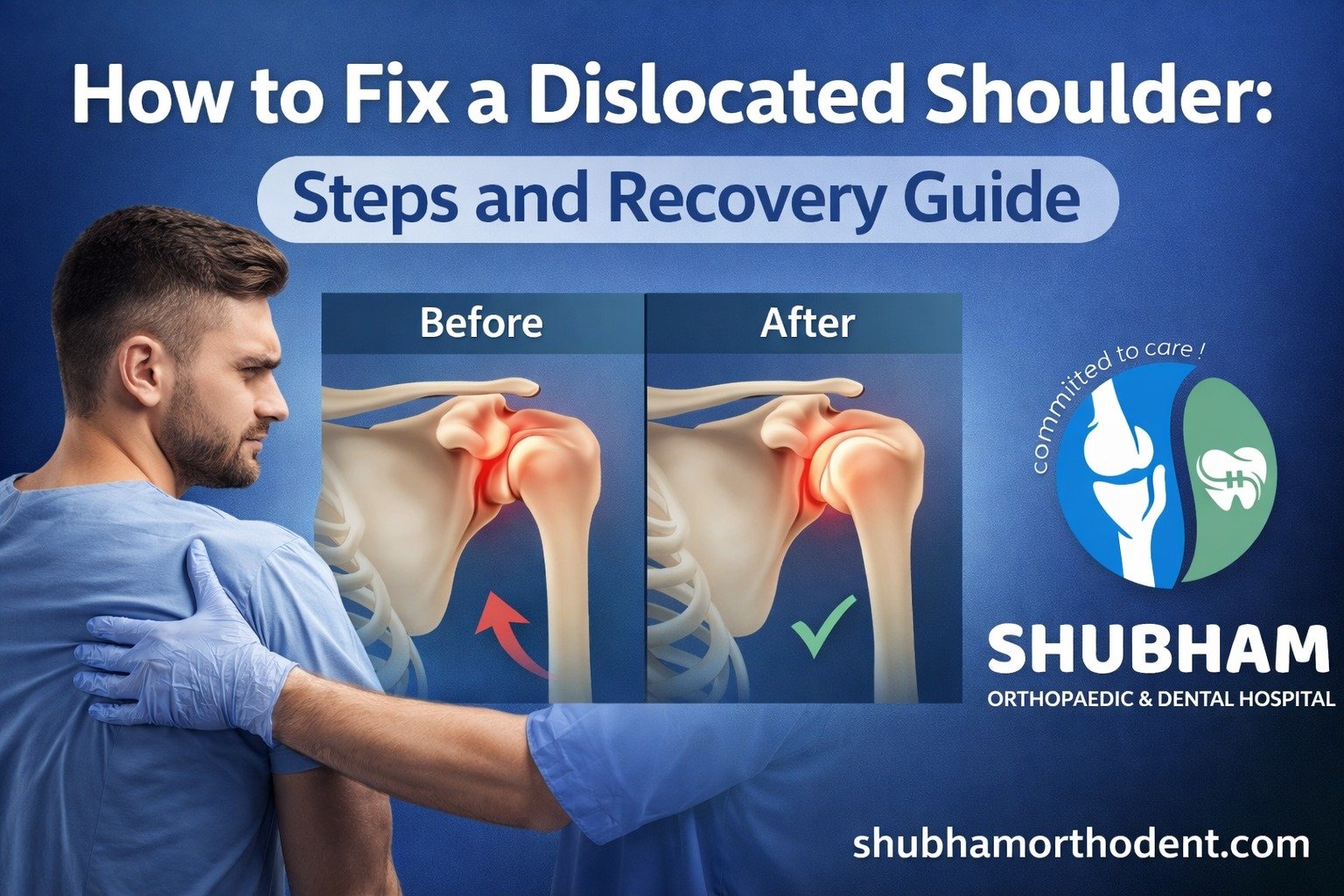
A dislocation occurs when the humerus (the ball at the top of your upper arm bone) is forced out of the glenoid (the cup-shaped socket in your shoulder blade).
A dislocation occurs when the humerus (the ball at the top of your upper arm bone) is forced out of the glenoid (the cup-shaped socket in your shoulder blade).
Partial vs. Full Dislocation
- Subluxation : This is a partial dislocation where the bone slips out and then moves back into place on its own.
- Full Dislocation : The bone is completely out of the socket and usually requires medical intervention to be put back.
Dislocated Shoulder Symptoms
A dislocated shoulder is usually obvious, but sometimes it can be confused with a severe strain or a fracture. Key signs include :
- Visible Deformity : The shoulder looks “squared off” or has a prominent bulge near the front.
- Intense Pain : Severe pain that worsens with any attempt to move the arm.
- Inability to Move the Joint : A complete loss of range of motion.
- Swelling and Bruising : Rapid inflammation around the joint area.
- Numbness or Tingling : If the dislocation is pressing on nerves or blood vessels, you may feel “pins and needles” down to your hand.
Immediate First Aid : What to Do (And What Not to Do)
If you suspect a dislocation, the first few minutes are critical for preventing further damage.
The "Do's" :
- Immobilize the Arm : Use a sling or a makeshift splint (like a folded scarf) to keep the arm close to the body.
- Apply Ice : Use an ice pack for 15–20 minutes to reduce internal bleeding and swelling.
- Seek Medical Help Immediately : Head to an emergency orthopaedic center.
The "Don'ts" :
- DO NOT try to pop it back in yourself. Attempting a “self-reduction” can tear ligaments, damage nerves, or even fracture the bone.
- Do not move the arm to “test” the injury.
“The shoulder is surrounded by a delicate network of nerves and blood vessels. Forcing the joint back into place without a clinical X-ray can turn a simple dislocation into a complex surgical case.” – Dr. Kushal Doshi, Lead Orthopaedic Surgeon at Shubham Hospital.
How a Surgeon Fixes a Dislocated Shoulder
Once you arrive at the hospital, the medical team will follow a specific protocol to restore the joint.
1. Diagnostic Imaging
A doctor will order an X-ray to confirm the direction of the dislocation (most are anterior, meaning the bone moved forward) and to check for associated fractures.
2. Closed Reduction
This is the process of physically moving the bone back into the socket. To make this comfortable, the doctor may use :
- Muscle relaxants
- Sedation
- Local anesthesia
3. Immobilization
After the “pop” back into place, the pain usually subsides significantly. However, the ligaments are still stretched. You will be placed in a sling for several days or weeks to allow the tissues to begin healing.
Common Causes and Risk Factors
- Sports Injuries : Contact sports like football, hockey, or basketball where collisions are frequent.
- Falls : Landing on an outstretched arm or directly on the shoulder.
- Trauma : Motor vehicle accidents are a leading cause of complex dislocations.
- Hypermobility : Some individuals are born with “loose” ligaments, making them more prone to the joint slipping out.
Dislocated Shoulder Recovery Time
Recovery is not just about the bone being back in place; it is about the soft tissue (labrum and ligaments) regaining their strength.
- Weeks 1-2 : Strict immobilization. Only gentle pendulum exercises as prescribed by your surgeon.
- Weeks 3-6 : Gradual introduction of passive range-of-motion exercises.
- Months 2-4 : Strength training focuses on the rotator cuff and scapular stabilizers.
- Months 6+ : Return to full-impact sports (pending medical clearance).
Shoulder Dislocation Physiotherapy and Strengthening
Rehabilitation is the most important phase for preventing chronic instability. At Shubham Orthopaedic & Dental Hospital, we focus on three pillars of rehab :
- Flexibility : Restoring the ability to reach overhead and behind the back.
- Proprioception : Training your brain to “know” where the joint is in space to prevent accidental slips.
- Strength : Building the muscles that hold the “ball” tight within the “socket.”
Preventing Future Shoulder Dislocations
Once a shoulder has dislocated once, the chance of it happening again increases, especially in younger, active patients.
- Wear Protective Gear : Use shoulder pads during sports.
- Maintain Strength : Never skip “shoulder day” at the gym; strong muscles act as internal splints.
- Listen to Your Body : If you feel “instability” or a clicking sensation, consult a specialist before a full dislocation occurs.
When to Consider Surgery
Not every dislocated shoulder needs surgery. However, surgery (usually minimally invasive arthroscopy) is recommended if :
- The dislocation happens repeatedly (Chronic Instability).
- There is a significant tear in the labrum (Bankart Lesion).
- The patient is a high-level athlete who needs a 100% stable joint.
Frequently Asked Questions (FAQs)
Q: How long does it take for a dislocated shoulder to heal?
While the bone is put back in minutes, full soft tissue healing typically takes 12 to 16 weeks.
Q: Can I drive with a dislocated shoulder?
No. You should not drive while wearing a sling or if your range of motion is impaired, as you cannot safely react to emergencies.
Q: Is a dislocated shoulder a permanent injury?
With proper rehabilitation, most people return to 100% function. However, without rehab, the joint may remain “loose” or prone to arthritis.
Summary
A dislocated shoulder is a painful injury that requires immediate medical attention. While first aid can help stabilize the joint temporarily, proper medical treatment is essential to prevent complications.
Treatment usually involves joint reduction, immobilization, physiotherapy, and in some cases surgery. With the right care and rehabilitation, most people recover fully within a few months. If you experience symptoms such as severe shoulder pain, restricted arm movement, or visible deformity, consult an orthopaedic specialist as soon as possible.
Treatment usually involves joint reduction, immobilization, physiotherapy, and in some cases surgery. With the right care and rehabilitation, most people recover fully within a few months. If you experience symptoms such as severe shoulder pain, restricted arm movement, or visible deformity, consult an orthopaedic specialist as soon as possible.